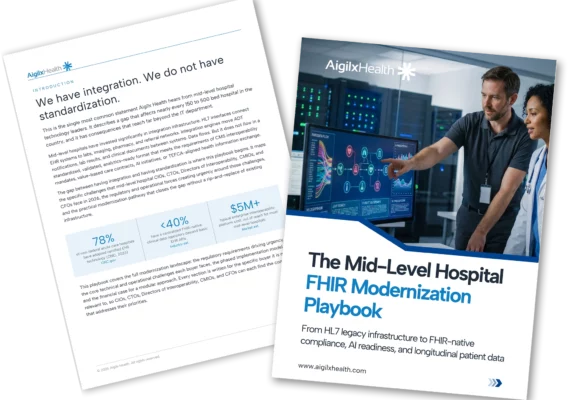
The Mid-Level Hospital FHIR Modernization Playbook
From HL7 integration to standardized, FHIR-native data for CMS compliance, AI readiness, and longitudinal patient records — built on top of the infrastructure you already run. For 150 to 500 bed hospitals, regional health systems, and community hospitals.
Inside This Playbook
We have integration. We do not have standardization. Here is how to close that gap.
Mid-level hospitals have invested heavily in integration infrastructure. HL7 interfaces connect the EHR to labs, imaging, pharmacy, and referral networks. Integration engines move ADT notifications, lab results, and clinical documents between systems. Data flows. But it does not flow in a standardized, validated, analytics-ready format that meets CMS interoperability expectations, value-based care contracts, AI initiatives, or TEFCA-aligned health information exchange. This playbook maps the regulatory forces, the specific challenges each buyer faces, a practical phased modernization pathway, and the financial case — including a real named deployment at Rochester RHIO.
What this playbook covers
02
Six buyer personas: what each of CIO, CTO, Director of Interoperability, CMIO, CFO, and Chief Quality Officer needs to see
03
Seven core challenges: HL7 normalization gap, disconnected systems, manual C-CDA reconciliation, CMS access gaps, AI data foundation, staff bandwidth, referral leakage
04
The RapidFire platform: HL7-to-FHIR conversion, FHIR CDR, SMART on FHIR APIs, AI data readiness, TEFCA connectivity — backed by HIPAA and HITRUST governance
05
Three-phase implementation: 90-day data foundation, compliance and access APIs, analytics and AI activation
06
Use cases: Rochester RHIO reference deployment, Provider Access readiness, AI pipeline enablement, referral leakage reduction
07
Objection handling: integration engines, EHR native APIs, budget constraints, and the HIE comparison
Get the Free eBook
For CIOs, CTOs, Directors of Interoperability, CMIOs, and CFOs at 150 to 500 bed hospitals.
By submitting you agree to our privacy policy. We never sell your data.
Key Takeaways
What mid-level hospital leaders walk away knowing
USCDI v3 becomes the certification baseline on January 1, 2026
USCDI v1 expires on that date under ONC’s HTI-1 Final Rule. USCDI v3 nearly doubles required data elements, adding SDOH, expanded patient characteristics, and more. EHR versions not yet updated will have material gaps in their API-accessible clinical data.
CMS-0057-F applies to payers — and creates strong downstream pressure on hospitals
The Prior Authorization Final Rule targets impacted payers, not hospitals directly. But as payers stand up FHIR-based Provider Access and prior-authorization APIs, hospitals that cannot participate in FHIR-based exchange will face growing friction in value-based programs and payer networks.
Information blocking disincentives, not CMPs, apply to providers
The $1M-per-violation civil monetary penalty applies to developers, HIEs, and HINs — not healthcare providers. Providers face Medicare program disincentives (Promoting Interoperability, MSSP) finalized by HHS in 2024. The practical obligation is the same: share electronic health information on request.
Your EHR's FHIR API is not a complete CMS compliance response
EHR-native FHIR APIs return only data generated inside that EHR. Independent LIS results, separate RIS imaging reports, outpatient practice-management records, and C-CDA documents from external providers are all absent. A complete patient record requires standardizing those external feeds on top of the EHR.
AI initiatives stall at the data layer, not the algorithm
A readmission risk model trained on inconsistently coded HL7 data that encounters ICD-10 in one source and SNOMED in another, with no mapping layer, will score the same condition differently across patients. The initiative stalls because the data is not standardized — not because the algorithm is wrong.
Phase 1 go-live in roughly 90 days without replacing anything
RapidFire taps the HL7 feeds your integration engine already runs, normalizes them to FHIR in parallel, and builds the FHIR CDR alongside existing infrastructure. Your EHR, your integration engine, and your interfaces all stay in place. Actual timelines depend on feeds, data quality, and access provisioning.
Who This Is For
Written for every decision maker in a mid-level hospital modernization conversation
CIO and CTO
Accountable for the modernization roadmap and CMS compliance posture. Wants modular deployment that fits budget cycles without enterprise licensing. Primary question: can we achieve compliance without replacing our EHR?
Director of Interoperability
Day-to-day owner of HL7 interface maintenance and data quality. Understands the message-routing versus standardization gap firsthand. Won over by a technical proof of concept on real data.
CMIO and Quality Officers
Frustrated by inconsistent data producing unreliable analytics. Evaluating whether the platform yields FHIR-based, eCQM-ready outputs. Primary question: will quality reporting become automated and reliable?
CFO and VP Finance
Comparing modular pricing against enterprise platform licensing. Chapter 8 provides an illustrative financial model covering cost avoided, revenue protected, labor reduced, and 3-year TCO.
Request your FHIR Readiness Assessment and see exactly where your gaps are
Two-week assessment. Delivered by Aigilx interoperability architects. No commitment required.

ISO 27001:2022 Certified
Aigilx health specializes in developing Interoperability solutions to create a healthcare ecosystem and aids in the delivery of efficient, patient-centric and population-focused healthcare.