Preparing for TEFCA and USCDI: why C-CDA quality assessment should be your first step
17 Aug
Key takeaways
- TEFCA requires all data created and sent to conform to USCDI v3 data classes, elements, and vocabulary as of January 1, 2026, a deadline that has already taken effect, according to the ONC Recognized Coordinating Entity’s own FAQ.
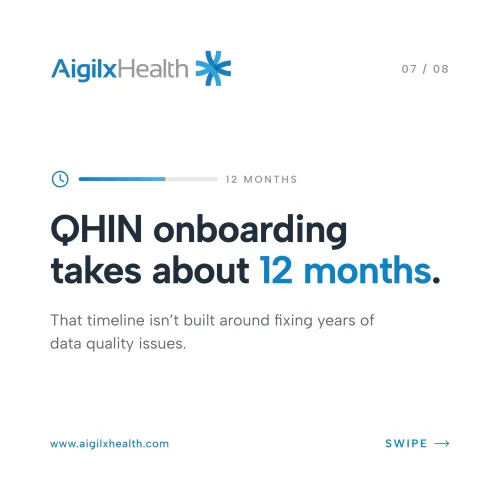
- Becoming a QHIN, or connecting through one as a participant, is a process that typically takes around 12 months, based on ONC’s own description of the onboarding timeline.
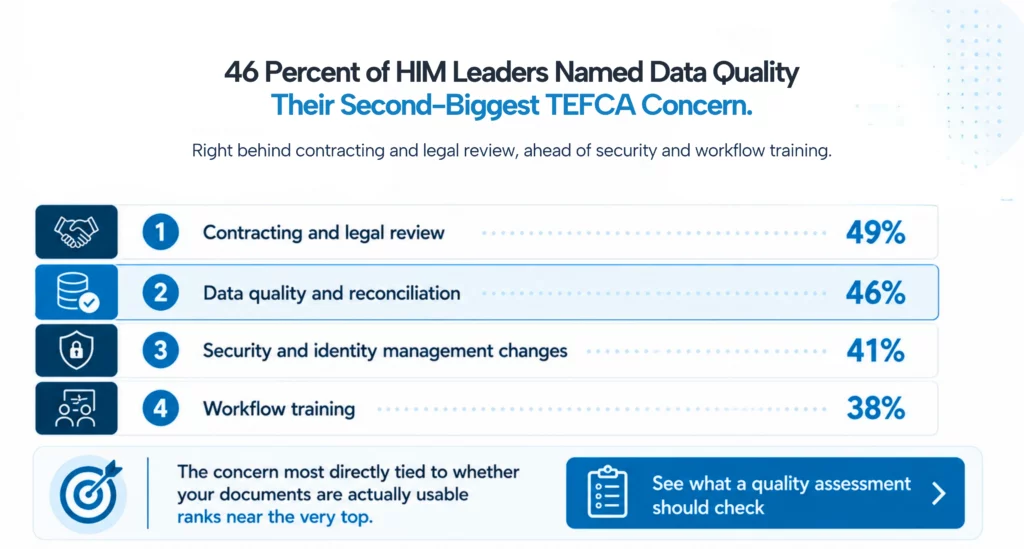
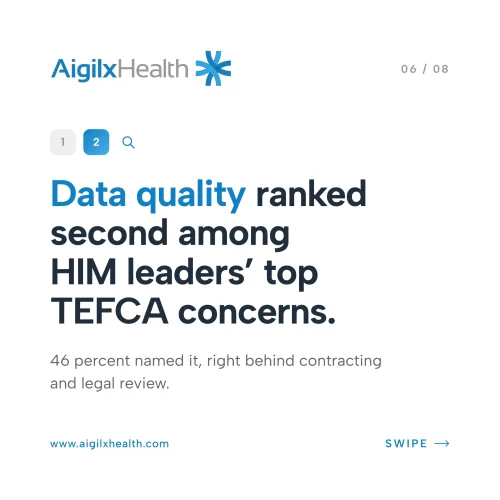
- A Black Book Research survey of HIM leaders conducted at AHIMA 2025 found data quality and reconciliation was the second-highest concern for TEFCA readiness, cited by 46 percent of respondents.
- The top use cases organizations expect to run through TEFCA in 2026, query for treatment, transitions of care, and referrals, are exactly the categories that rely heavily on C-CDA document exchange today.
- A QHIN connection changes how data moves. It does not change whether the C-CDA documents an organization sends are complete, correctly coded, or USCDI-conformant.
- Most organizations expect to keep existing HIE connections running alongside TEFCA rather than replacing them outright, which means C-CDA quality issues will surface in both channels, not just the new one.
- Assessing C-CDA quality before onboarding gives an organization time to fix what it finds. Discovering the same gaps during or after onboarding leaves far less room to correct them.
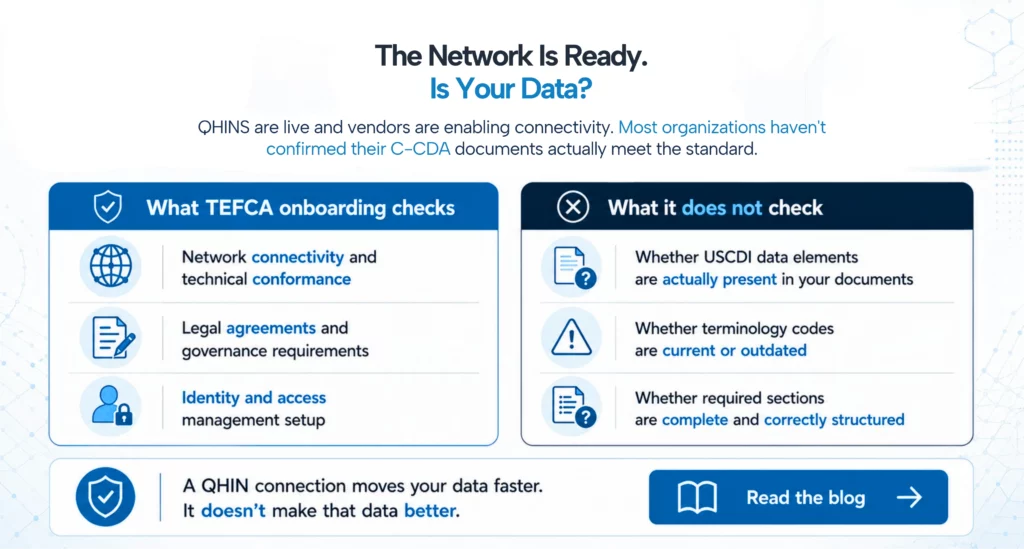
A health information management team gets the mandate: get ready for TEFCA. Legal starts reviewing the Common Agreement. IT starts scoping the QHIN connection. Almost nobody starts by asking whether the C-CDA documents the organization already produces are good enough to exchange nationally once that connection goes live.
That gap matters more than most onboarding checklists suggest. A recent flash survey of health information management leaders found data quality and reconciliation was the second-highest concern going into TEFCA participation, right behind contracting and legal review. Most of what flows through TEFCA today for treatment, transitions of care, and referrals still travels as a C-CDA document, and a QHIN connection does not fix bad data inside the documents passing through it
This article looks at what TEFCA and USCDI require right now, why C-CDA quality sits underneath nearly every use case driving TEFCA adoption, and why assessing that quality belongs at the start of preparation, not somewhere in the middle of onboarding.
Table of contents
Why is TEFCA readiness suddenly an active budget conversation?
TEFCA has moved from a policy discussion to an operational one. QHINs are live, EHR vendors are enabling production connectivity, and the Common Agreement’s requirements are already in effect for organizations connecting through a designated network.
That shift shows up directly in how HIM leaders are planning, or in many cases not yet planning, for it. A Black Book Research flash survey of 97 HIM leaders at AHIMA 2025 found 61 percent had no FY26 budget line set for TEFCA onboarding and testing, even as vendor connectivity continues to expand around them.
What does USCDI v3 require, and when does it apply?
The QHIN Technical Framework sets a specific, dated requirement: data created or captured and sent had to conform to USCDI v1 starting December 31, 2024, and as of January 1, 2026, that requirement steps up to USCDI v3 data classes, data elements, and vocabulary, according to the ONC Recognized Coordinating Entity’s own FAQ.
That date has already passed. Any organization exchanging data through TEFCA today is expected to meet the USCDI v3 standard now, not at some point in a future planning cycle, which raises the practical question of whether the data an organization is already producing meets it.
Why does C-CDA quality matter specifically for TEFCA participation?
TEFCA supports FHIR-based exchange, but a large share of real-world clinical exchange happening today, and expected to continue happening through TEFCA, still moves as C-CDA documents. The same Black Book survey found the top expected 2026 use cases were query for treatment at 71 percent, transitions of care at 52 percent, and referrals at 39 percent, each one a category historically built around C-CDA-based document exchange.
A QHIN connection is a transport and governance layer. It moves data reliably and under a shared legal framework, but it has no way to improve what is inside a document that arrives incomplete, miscoded, or missing required USCDI data elements. Connecting a poor-quality data source to a faster, wider exchange network just moves the same quality problem to more places, faster.
What did HIM leaders identify as their top TEFCA readiness concerns?
Top TEFCA readiness concerns, Black Book Research survey of HIM leaders
| Concern | Share of respondents |
|---|---|
| Contracting and legal review | 49 percent |
| Data quality and reconciliation | 46 percent |
| Security and identity and access management changes | 41 percent |
| Workflow training | 38 percent |
What does a C-CDA quality assessment check?
What a C-CDA quality assessment should cover
| Check | What it confirms |
|---|---|
| USCDI data class coverage | Whether required data classes and elements are present and populated in the document |
| Terminology accuracy | Whether codes used match current LOINC, SNOMED CT, RxNorm, and ICD-10 standards, not outdated or local codes |
| Structural completeness | Whether required sections, like problem list, medications, and allergies, are present and correctly formatted |
| Referential consistency | Whether patient and encounter references within the document are accurate and internally consistent |
| Document type coverage | Whether the full range of document types an organization produces has been assessed, not just the most common one |
Why should this happen before QHIN onboarding, not during it?
QHIN onboarding is a defined process with its own testing and conformance requirements, and it typically takes around 12 months to complete, according to ONC’s own description of the process. That timeline is built around network and governance readiness, not around fixing years of accumulated data quality issues discovered midstream.
Finding a terminology gap or a missing USCDI element during onboarding testing turns a data quality project into an onboarding delay. Finding the same gap months earlier, through a dedicated quality assessment, turns it into a planned remediation project with a realistic timeline, run in parallel with the rest of onboarding rather than blocking it.
What should organizations do in the next few months?
- Run a C-CDA quality assessment before finalizing a QHIN onboarding timeline, so any remediation work can happen in parallel rather than blocking the connection later.
- Confirm USCDI v3 conformance specifically, since that requirement is already in effect, not a future milestone to plan around.
- Prioritize the document types tied to your top expected use cases, particularly transitions of care and referral documents, given how heavily TEFCA use is expected to concentrate there.
- Set a FY26 budget line for onboarding and remediation together, rather than treating data quality work as a separate, unfunded effort.
- Plan for parallel operation with existing HIE connections, since most organizations expect to keep those running rather than replacing them outright.
Where does this leave organizations planning their TEFCA participation?
TEFCA readiness is not primarily a network problem right now. The connections, the vendor support, and the governance framework are already operational. What most organizations have not yet confirmed is whether the data they plan to send through that network actually meets the standard it is required to meet.
A C-CDA quality assessment answers that question early enough to matter, while there is still time to fix what it finds rather than discovering it during a conformance test with a QHIN onboarding clock already running.
For a closer look at what that same rigor requires once quality data needs to feed analytics and AI tools, see how automated C-CDA to FHIR conversion accelerates AI, analytics, and population health. (Blog yet to be gone live interlink)
FAQs
It is already in effect. The requirement took effect January 1, 2026, according to the ONC Recognized Coordinating Entity, meaning organizations exchanging data through TEFCA now are expected to meet it currently.
Around 12 months, according to ONC's own description of the application, onboarding, and designation process.
Because a survey of HIM leaders found it was the second-highest concern overall, tied directly to whether the data an organization exchanges will actually be usable once it moves through a QHIN connection.
No. A QHIN connection is a transport and governance layer. It moves data more broadly and reliably, but it does not correct missing elements, outdated codes, or structural gaps already present in the source documents.
Not for most organizations in the near term. Most expect to maintain existing HIE connections alongside TEFCA rather than retiring them immediately.
A C-CDA quality assessment, run before finalizing an onboarding timeline, so any remediation work can happen on a realistic schedule instead of surfacing as a delay during onboarding testing.
Categories
- 1115 Waiver (8)
- ACO (7)
- AI (48)
- Aigilx Health (48)
- CCBHC (8)
- Control Center (10)
- FHIR Facade (7)
- FHIR Server (14)
- HIE (5)
- Payers (8)
- Providers (11)
- Rapid Fire (9)

ISO 27001:2022 Certified
Aigilx health specializes in developing Interoperability solutions to create a healthcare ecosystem and aids in the delivery of efficient, patient-centric and population-focused healthcare.