Why healthcare AI startups lose enterprise deals at the IT review stage and what FHIR readiness actually requires
17 Jul
Why healthcare AI startups lose enterprise deals at the IT review stage and what FHIR readiness actually requires
Key takeaways
- Most healthcare AI deals do not die in the demo. They die at IT review, months after the clinical champion is already sold.
- FHIR readiness is not the same as “we can connect to an EHR.” It means supporting specific FHIR resources, USCDI data classes, and authorization standards that ONC has built into the federal certification program.
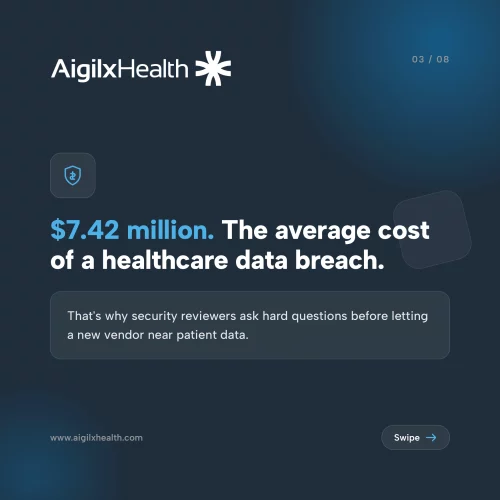
- Healthcare data breaches average $7.42 million per incident, the highest of any industry tracked for 14 consecutive years, according to IBM’s 2025 Cost of a Data Breach Report.
- Enterprise health systems increasingly expect SOC 2 Type II or equivalent security attestation before a security review even begins, not as an outcome of it.
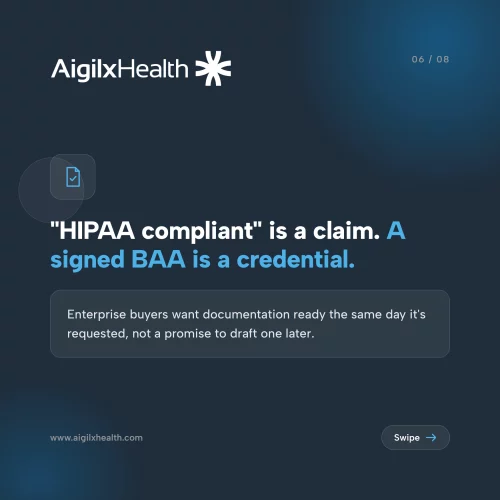
- “HIPAA compliant” is a starting claim, not a credential. Enterprise buyers want documentation: a signed Business Associate Agreement, a data flow diagram, and clear answers about model training on customer data.
- FHIR R4 is the mature version incorporated into the ONC Health IT Certification Program under the 21st Century Cures Act, and enterprise buyers increasingly expect vendors to already build on it.
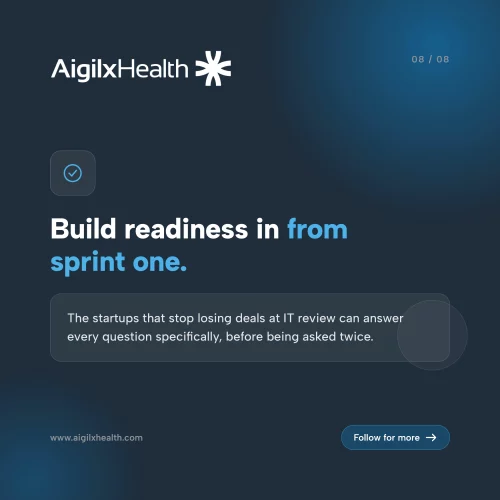
- The fix is not a bigger sales team. It is bringing security and interoperability readiness into the product from the first sprint, not as a pre-close scramble.
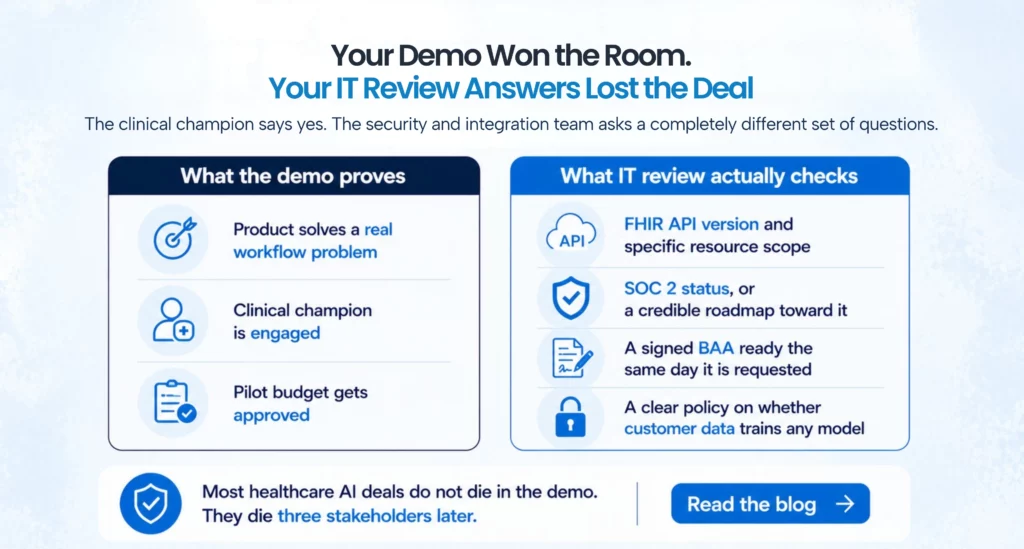
A healthcare AI startup closes a strong demo. The clinical champion is sold. The pilot budget is approved. Then the deal sits for six months while a health system’s IT and security team asks questions nobody on the founding team prepared for.
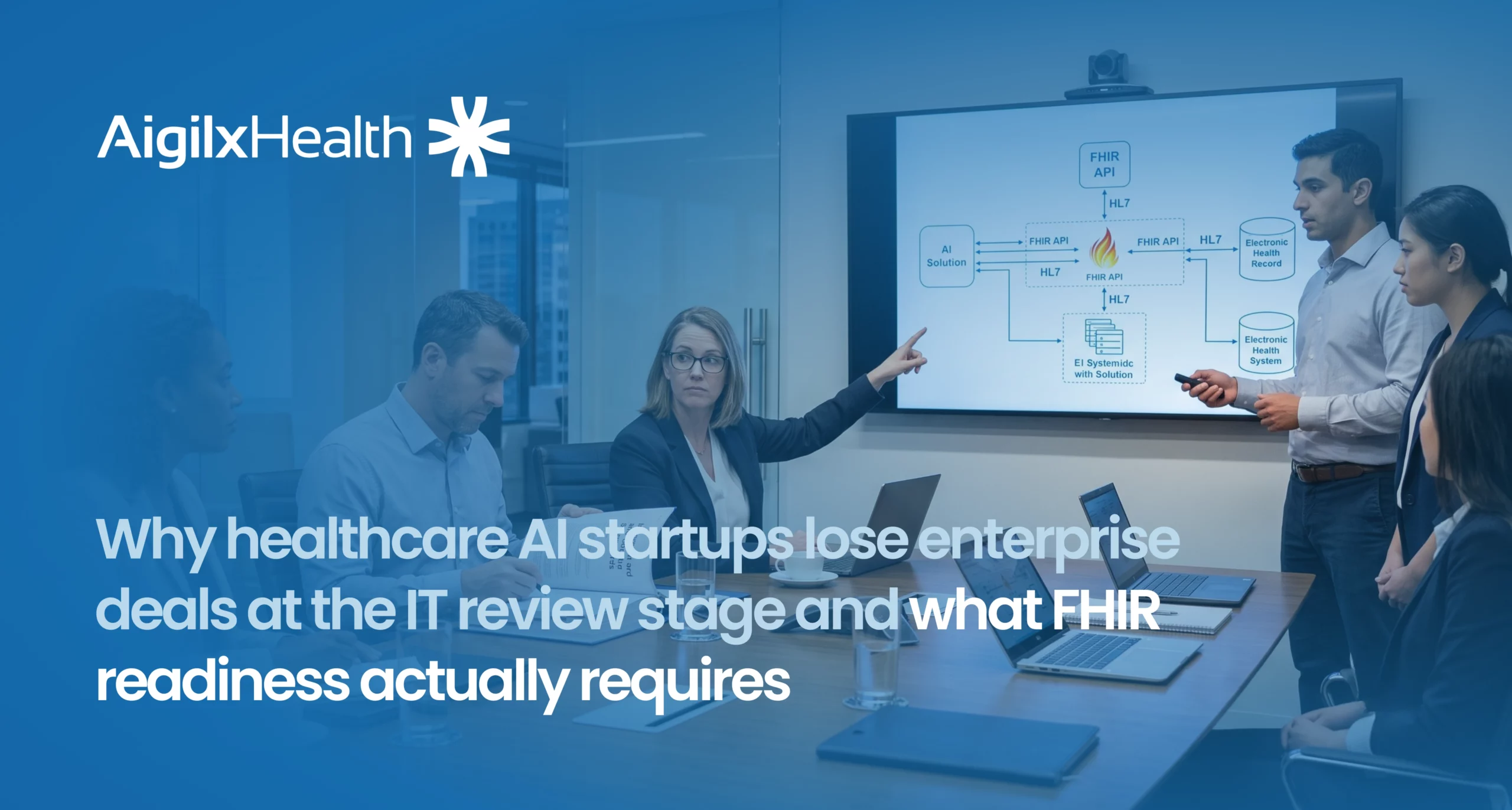
This is not a rare story. It is the default pattern for healthcare AI vendors who treat interoperability and security as something to figure out after the first enterprise conversation, rather than before it. When the IT review starts asking about FHIR API support, USCDI data classes, and SOC 2 status, the deal has already stalled.
This piece breaks down why the IT review stage kills more healthcare AI deals than the sales process ever admits, what FHIR readiness actually means in practical terms, and what has to be true before a founding team walks into an enterprise health system conversation.
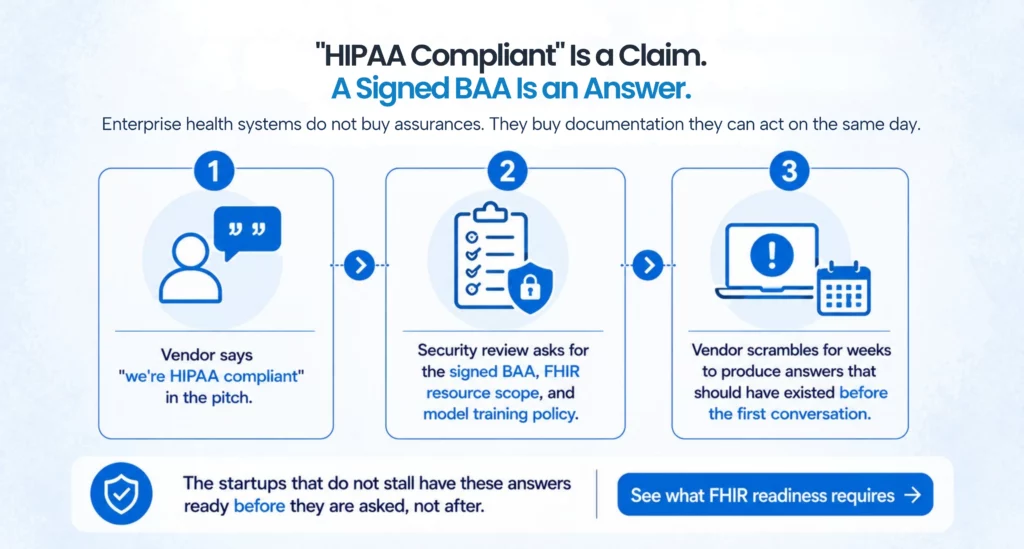
Table of contents
Why do healthcare AI deals stall at IT review instead of the demo?
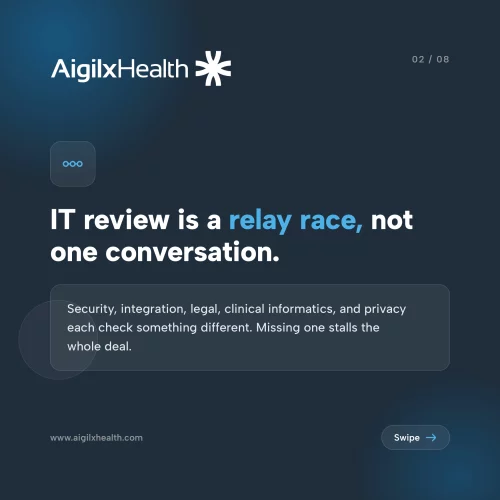
Enterprise healthcare procurement is not one conversation. It is a relay race between stakeholders with different mandates: a clinical champion, a procurement team, an IT integration team, and a security or compliance reviewer.
A demo only has to satisfy the first of those. The clinical champion cares whether the product solves a real workflow problem. IT and security care about something else entirely: whether the product can be trusted to touch patient data inside a regulated environment without introducing new risk.
Most early-stage healthcare AI teams optimize heavily for the first conversation and treat the second as a formality to handle later. That is exactly backwards, since the second conversation is where deals actually die.
What does IT review actually evaluate that a demo never tests?
IT and security review is not a single checklist. It is a sequence of evaluations, and each one can independently stall a deal.
What each stakeholder in enterprise health IT review actually checks
Reviewer | What they evaluate | Common question that stalls a deal |
Security/compliance | Data handling, access controls, breach history | “Do you have SOC 2 Type II or equivalent?” |
IT integration | Interoperability with existing EHR and systems | “Does this support our FHIR API version, or do we need custom middleware?” |
Legal/procurement | Contractual data protection terms | “Can you send a signed Business Associate Agreement today?” |
Clinical informatics | Data provenance and model behavior | “What data was this model trained on, and can we audit its outputs?” |
Privacy officer | PHI handling and third-party data flows | “Does any patient data leave our environment, and where does it go?” |
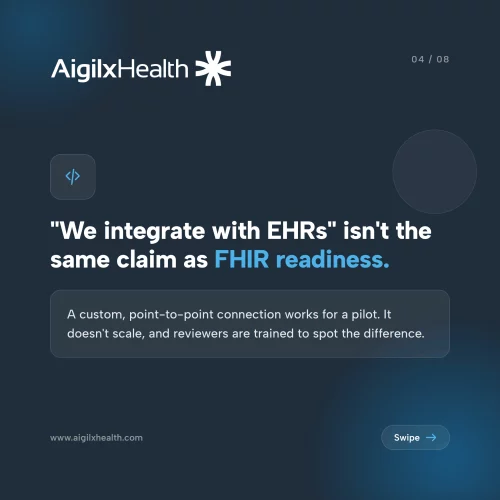
What is FHIR, and why does it matter more than "we integrate with EHRs"?
What does FHIR readiness actually require?
FHIR readiness is a specific, checkable set of capabilities, not a vague claim a vendor can assert in a pitch deck.
FHIR readiness checklist
Requirement | What it means | Why IT review checks for it |
FHIR R4 API support | The product can read and write data using current FHIR resources | R4 is the version built into ONC-certified systems |
USCDI data class alignment | The product maps its data to United States Core Data for Interoperability classes | This is the ONC-defined baseline for what “interoperable” data actually means |
SMART on FHIR authorization | The product uses standards-based OAuth2 authorization, not a custom login flow | This is how certified EHRs control third-party app access |
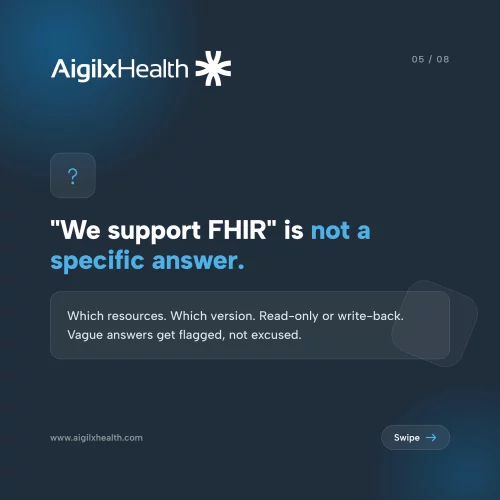
Defined FHIR resource scope | The vendor can state exactly which FHIR resources (Patient, Observation, MedicationRequest, etc.) it reads or writes | Vague answers here are treated as a red flag, not a nuance |
Bidirectional vs. read-only clarity | The vendor is explicit about whether it only reads data or also writes back to the EHR | Write-back access carries materially higher scrutiny and risk |
Audit logging | Every data access and AI-driven action is logged and traceable | Required for any AI output that influences a clinical or operational decision |
Why doesn't "HIPAA compliant" satisfy an enterprise buyer?
“HIPAA compliant” is often used as a blanket assurance in early-stage sales conversations. Enterprise buyers do not treat it as a credential, because HIPAA compliance is a legal obligation, not a certification with an independent audit trail behind it.
What enterprise buyers actually want is documentation: a signed Business Associate Agreement (BAA) ready to send the same day it is requested, a clear answer about whether customer data is used to train models, and a data flow diagram showing exactly where PHI travels and who can access it.
Ambiguity here is treated as a red flag, not a nuance. If a startup’s privacy policy is unclear about whether customer data trains its models, security reviewers assume the answer is yes and flag it accordingly.
What should a startup have ready before the first enterprise conversation?
- A signed, ready-to-send Business Associate Agreement, not a promise to draft one once asked.
- A specific FHIR resource and version statement, naming exactly which resources and FHIR release the product supports.
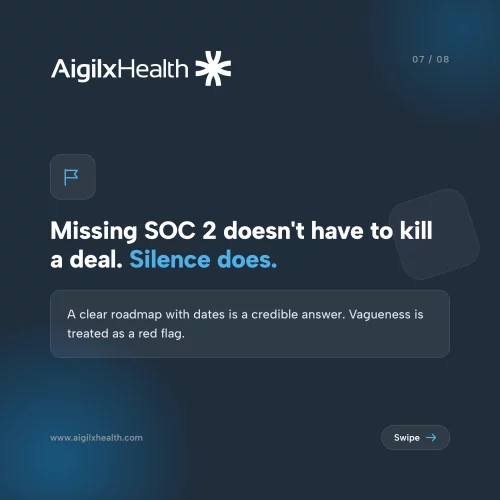
- SOC 2 Type II or a clear roadmap toward it, since its absence is one of the most common reasons mid-market healthcare deals stall.
- A written answer on model training data, stating plainly whether customer data trains any model, and what the opt-out looks like if it does.
- Role-based access controls and audit logging, built in from the start rather than added before a specific customer’s review.
- A data flow diagram, showing where PHI moves, where it is stored, and which subprocessors touch it.
Where does this leave founders building for enterprise health systems?
The pattern is consistent across healthcare AI startups that lose deals at IT review: strong product, engaged champion, and a founding team that treated interoperability and security readiness as something to solve after traction, not before it.
FHIR readiness and security documentation are not compliance overhead sitting outside the product. They are part of what “enterprise-ready” actually means in healthcare, and they can be built in from the first sprint rather than retrofitted under deal pressure.
The startups that stop losing deals at this stage are not necessarily the ones with the most polished demo. They are the ones who can answer every question in the tables above specifically, on the spot, before a reviewer has to ask twice.
FAQs
Not always before the first conversation, but its absence is one of the most common reasons deals stall in the mid-market. Starting the process early, and being transparent about timeline, matters more than having it finished on day one.
No. IT review does not expect universal coverage. It expects a startup to clearly state which specific resources it supports and to be accurate about that scope, rather than implying broader support than actually exists.
HL7 v2 is an older messaging standard still running inside many live EHR environments. FHIR is the modern, structured, API-based standard that ONC has built into current certification requirements. Many health systems still run both.
No. Write-back access, where a vendor's product sends data into the EHR rather than only reading from it, carries materially higher security scrutiny, since it introduces a new way patient records can be altered.
Yes, especially early on, but someone on the founding team needs to own security and interoperability readiness as a real responsibility, not an afterthought handled reactively when a deal stalls.
It varies widely, but interoperability and security reviews commonly extend enterprise healthcare sales cycles to several months, particularly when a vendor is unprepared for the specific questions being asked.
Categories
- 1115 Waiver (8)
- ACO (7)
- AI (48)
- Aigilx Health (48)
- CCBHC (8)
- Control Center (10)
- FHIR Facade (7)
- FHIR Server (14)
- HIE (5)
- Payers (8)
- Providers (11)
- Rapid Fire (9)

ISO 27001:2022 Certified
Aigilx health specializes in developing Interoperability solutions to create a healthcare ecosystem and aids in the delivery of efficient, patient-centric and population-focused healthcare.