FHIR vs HL7: What Healthcare Organizations Need to Know in 2026
29 Jun
FHIR vs HL7: What Healthcare Organizations Need to Know in 2026
Healthcare interoperability is rapidly becoming one of the most important priorities for healthcare organizations in 2026.
As healthcare systems become increasingly connected, providers, payers, health systems, and digital health organizations are under growing pressure to improve healthcare data exchange, care coordination, patient access, and compliance readiness. At the center of this transformation are two major interoperability standards: HL7 and FHIR.
While many healthcare leaders have heard these terms used interchangeably, they are not the same thing. Understanding the differences between HL7 and FHIR is becoming essential for healthcare organizations planning modernization initiatives, API-driven healthcare infrastructure, digital health innovation, and interoperability compliance strategies.
In 2026, healthcare organizations that fail to modernize interoperability capabilities may struggle with fragmented systems, operational inefficiencies, compliance challenges, and limited scalability.
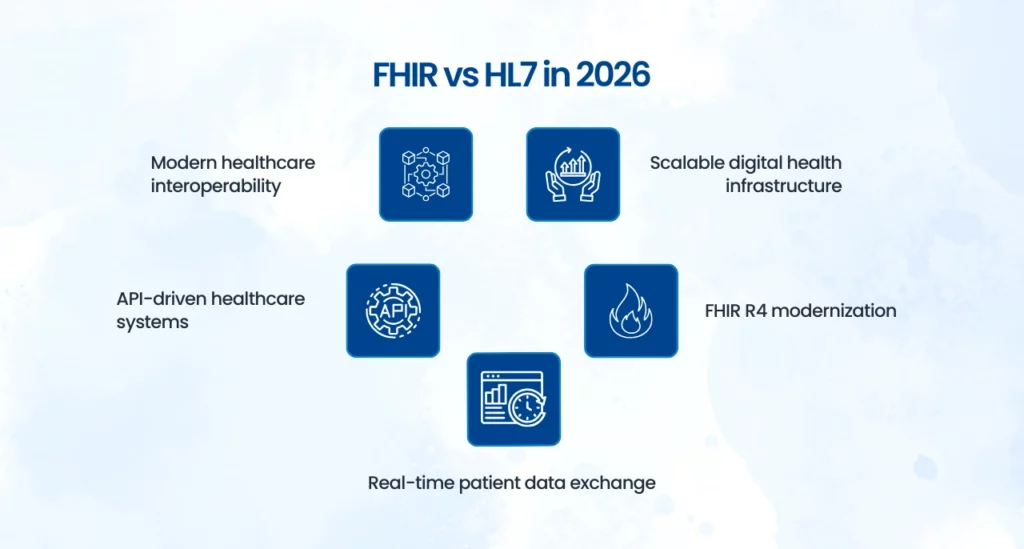
FHIR is increasingly emerging as the modern interoperability framework that supports connected healthcare ecosystems, while HL7 remains deeply embedded across legacy healthcare infrastructures. Understanding how both standards work together is critical for future-ready healthcare operations.
What Is HL7?
HL7 stands for Health Level Seven.
It is a set of international healthcare interoperability standards developed to enable healthcare systems to exchange clinical and administrative data.
HL7 has been widely used across healthcare organizations for decades and became foundational to healthcare integration long before modern APIs existed.
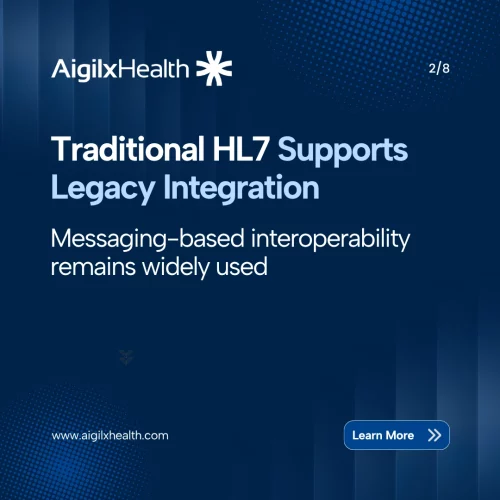
Traditional HL7 standards primarily support messaging-based communication between healthcare systems.
HL7 enables exchange of data such as:
- Patient admissions and discharges
- Laboratory results
- Billing information
- Clinical documentation
- Scheduling data
- Referral workflows
- Claims processing information
HL7 standards became essential because healthcare organizations historically operated disconnected systems that struggled to share information effectively.
Many hospitals, health systems, and healthcare vendors still rely heavily on HL7-based integrations today.
What Is FHIR?
FHIR stands for Fast Healthcare Interoperability Resources.
FHIR is a modern interoperability standard developed by HL7 to improve healthcare data exchange using API-driven communication.
Unlike traditional HL7 messaging systems, FHIR uses web-based technologies similar to modern consumer applications.
FHIR supports:
- Real-time healthcare data exchange
- API-based interoperability
- Structured healthcare resources
- Secure patient data access
- Cloud-based healthcare integration
- Mobile health applications
- SMART on FHIR app integration
- Modern digital healthcare workflows
FHIR is designed to make healthcare interoperability faster, more scalable, and easier to implement across healthcare ecosystems.
In simple terms, FHIR modernizes how healthcare systems communicate with one another.
The Core Difference Between FHIR and HL7
One of the biggest misconceptions in healthcare IT is assuming HL7 and FHIR are competing technologies.
In reality, FHIR is part of the broader HL7 ecosystem.
The main difference lies in how healthcare data is exchanged.
Traditional HL7 Integration
Older HL7 standards primarily use message-based communication.
These integrations often require:
- Custom interfaces
- Complex integration engines
- Point-to-point connections
- Significant manual maintenance
- Vendor-specific workflows
Traditional HL7 environments can become difficult to scale over time, especially when organizations use multiple disconnected healthcare systems.
FHIR Integration
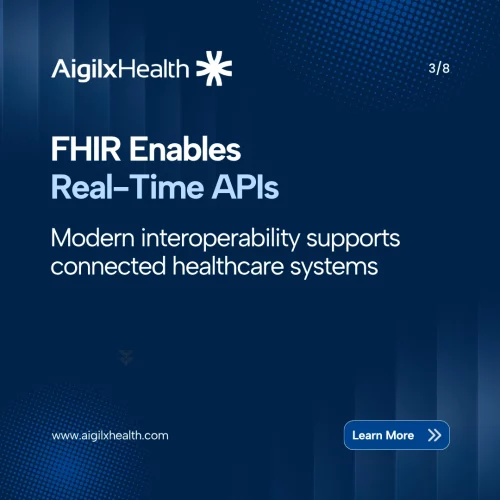
FHIR uses API-based interoperability.
This allows healthcare systems to exchange data in real time through standardized APIs.
FHIR supports:
- Faster implementation
- Improved scalability
- Easier application integration
- Real-time patient data access
- Cloud-native interoperability
- Better digital health experiences
FHIR is designed for modern healthcare ecosystems where healthcare data must move securely across multiple systems, devices, applications, and providers.
Why Healthcare Organizations Still Use HL7
Despite the rapid growth of FHIR adoption, HL7 remains deeply embedded in healthcare operations.
Many healthcare organizations continue using HL7 integrations because:
- Existing EHR systems rely on HL7 workflows
- Legacy infrastructure is expensive to replace
- Core hospital systems still use HL7 messaging
- Long-standing integrations remain operational
- Many healthcare vendors continue supporting HL7 interfaces
Healthcare modernization does not happen overnight.
As a result, many organizations now operate hybrid interoperability environments that combine both HL7 and FHIR capabilities.
Why FHIR Adoption Is Accelerating in 2026
Healthcare interoperability requirements are evolving rapidly.
Federal healthcare initiatives increasingly focus on:
- Patient access APIs
- Real-time healthcare data exchange
- Interoperability compliance
- Connected healthcare ecosystems
- Value-based care enablement
- Digital patient engagement
- Healthcare analytics modernization
FHIR is becoming central to these modernization efforts because it enables healthcare organizations to build scalable, API-driven healthcare infrastructures.
FHIR adoption is accelerating due to:
1. CMS Interoperability Requirements
Healthcare organizations are under growing pressure to support standardized patient access and healthcare data exchange.
2. Digital Health Innovation
Modern healthcare applications increasingly rely on FHIR APIs.
3. Telehealth Expansion
Connected virtual care ecosystems require real-time interoperability.
4. Population Health Initiatives
Data-driven care models depend on connected healthcare systems.
5. Healthcare Consumer Expectations
Patients increasingly expect digital-first healthcare experiences.
Understanding HL7 Versions in Healthcare
Healthcare leaders often hear references to different HL7 versions.
The most common include:
HL7 v2
HL7 Version 2 remains one of the most widely used healthcare messaging standards globally.
It supports:
- Admissions
- Discharges
- Transfers
- Lab messaging
- Clinical notifications
- Billing workflows
Many healthcare organizations still depend heavily on HL7 v2 integrations.
HL7 v3
HL7 v3 introduced more structured interoperability models but experienced slower adoption due to implementation complexity.
CDA and CCD
Clinical Document Architecture (CDA) and Continuity of Care Documents (CCD) became important for document-based healthcare information exchange.
FHIR
FHIR represents the next evolution of healthcare interoperability using APIs and modular healthcare resources.
What Is FHIR R4?
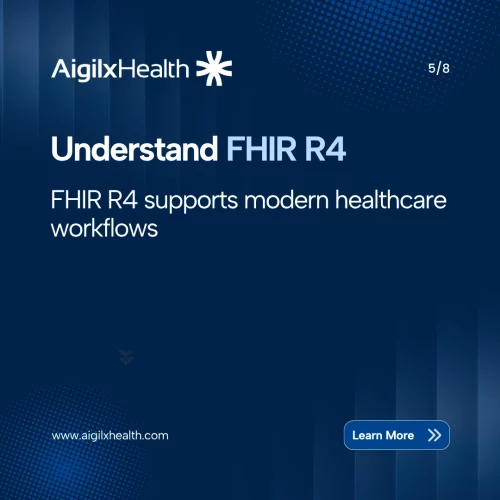
FHIR R4 (Release 4) is one of the most widely adopted versions of FHIR in healthcare ecosystems.
FHIR R4 supports:
- Standardized healthcare APIs
- Structured healthcare resources
- SMART on FHIR integration
- Improved scalability
- Better developer adoption
- Modern healthcare workflows
FHIR R4 has become a major focus for healthcare modernization initiatives in 2026.
f(x)=Real-Time Healthcare Data Exchangef(x)=\text{Real-Time Healthcare Data Exchange}f(x)=Real-Time Healthcare Data Exchange
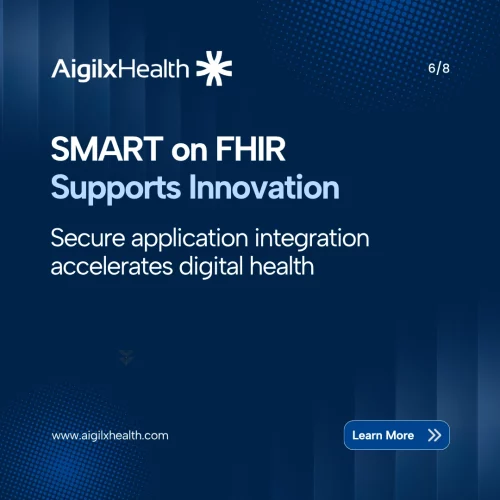
What Is SMART on FHIR?
SMART on FHIR is a healthcare application framework built on top of FHIR standards.
It allows healthcare organizations to integrate third-party healthcare applications securely into existing healthcare systems.
SMART on FHIR enables:
- Secure authentication
- Standardized app integration
- Real-time clinical data access
- Enhanced provider workflows
- Better patient engagement
- Faster healthcare innovation
SMART on FHIR is playing a major role in healthcare application ecosystems across hospitals, health systems, and digital health platforms.
FHIR vs HL7: Key Differences
Feature | Traditional HL7 | FHIR |
Integration Style | Messaging-based | API-based |
Implementation Complexity | High | Lower |
Scalability | Limited | High |
Real-Time Access | Limited | Strong |
Mobile Support | Minimal | Extensive |
Cloud Compatibility | Limited | Strong |
App Integration | Complex | Easier |
Developer Accessibility | Lower | Higher |
Modern Digital Workflows | Limited | Strong |
Healthcare Innovation Support | Moderate | High |
Why FHIR Matters for Healthcare Modernization
Healthcare organizations are increasingly adopting FHIR because modern healthcare ecosystems require interoperability at scale.
FHIR helps healthcare organizations:
- Improve care coordination
- Reduce data silos
- Modernize healthcare workflows
- Strengthen compliance readiness
- Support healthcare analytics
- Enable patient-centered care
- Improve operational visibility
- Accelerate digital transformation
FHIR creates a scalable interoperability foundation for long-term healthcare innovation.
Common Challenges With HL7 Integration
Traditional HL7 integrations can create several operational challenges over time.
These may include:
Complex Interface Management
Point-to-point integrations can become difficult to maintain across large healthcare ecosystems.
Limited Real-Time Data Exchange
Older messaging frameworks may delay data availability.
Vendor-Specific Customization
Healthcare organizations often rely on heavily customized interfaces.
Scalability Limitations
Legacy architectures can make modernization difficult.
Integration Maintenance Costs
Complex HL7 environments often require ongoing technical support.
These challenges are one reason many healthcare organizations are investing in API-driven modernization strategies.
Can Healthcare Organizations Use Both HL7 and FHIR?
Yes.
In fact, many healthcare organizations currently operate hybrid interoperability environments.
Rather than replacing all existing infrastructure, organizations often:
- Maintain existing HL7 integrations
- Add FHIR APIs gradually
- Implement interoperability overlays
- Modernize workflows incrementally
- Enable API access alongside legacy systems
This phased modernization strategy reduces operational disruption while improving interoperability capabilities over time.
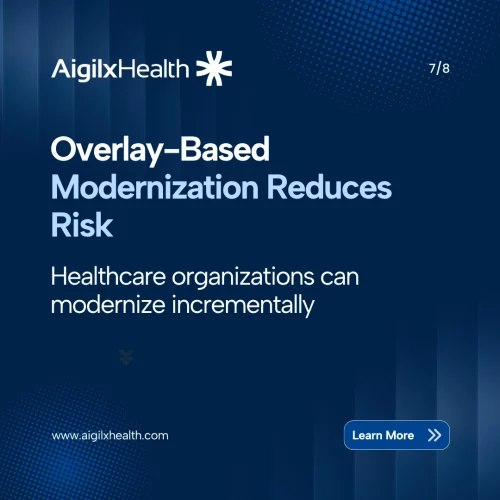
Overlay-Based Modernization Is Growing
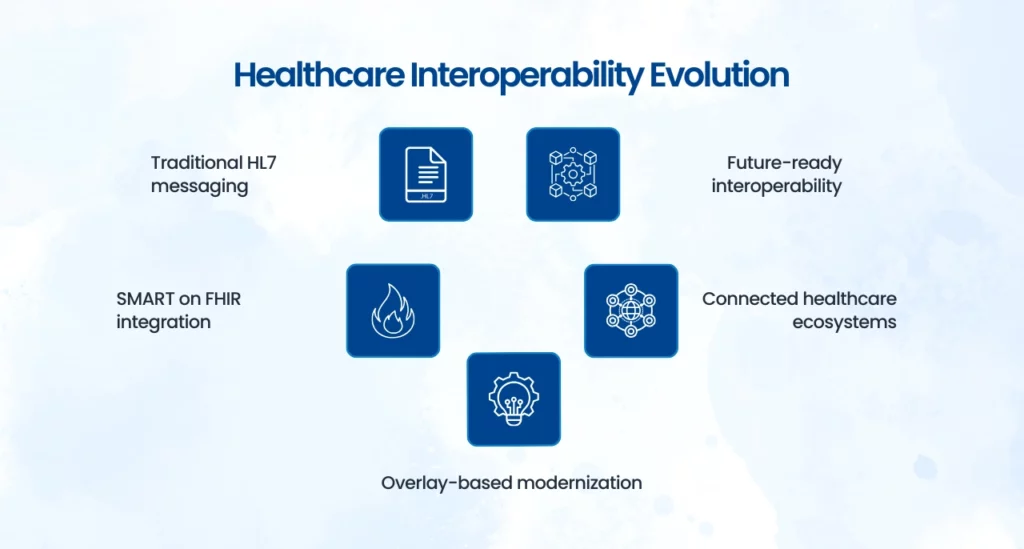
One of the biggest healthcare interoperability trends in 2026 is overlay-based modernization.
Rather than replacing core systems completely, healthcare organizations are:
- Adding FHIR interoperability layers
- Modernizing APIs incrementally
- Integrating cloud-based applications
- Enabling SMART on FHIR capabilities
- Improving interoperability scalability
Overlay-based modernization helps healthcare organizations modernize faster while protecting existing investments.
Signs Your Healthcare Organization Needs Interoperability Modernization
Healthcare leaders should evaluate whether their organization experiences:
- Frequent manual data exchange
- Disconnected healthcare applications
- Delayed care coordination
- Difficulty integrating digital health tools
- Limited analytics visibility
- Duplicate patient records
- Heavy interface maintenance burdens
- Limited API capabilities
- Compliance readiness concerns
These are often indicators of interoperability limitations.
How Healthcare Organizations Can Prepare for FHIR Adoption
Successful interoperability modernization begins with a phased strategy.
Healthcare organizations should focus on:
Assessing Existing Integration Environments
Identify current HL7 dependencies and interoperability gaps.
Evaluating API Readiness
Determine whether existing systems support FHIR APIs and SMART on FHIR integration.
Prioritizing High-Impact Workflows
Focus on patient access, referrals, care coordination, and analytics first.
Building Incremental Modernization Plans
Adopt phased interoperability transformation strategies.
Strengthening Governance and Security
Ensure interoperability initiatives align with healthcare compliance requirements.
Supporting Long-Term Scalability
Create interoperability frameworks that support future healthcare innovation.
Why FHIR Is Becoming the Future of Healthcare Interoperability
Healthcare ecosystems are rapidly evolving toward API-driven healthcare infrastructure.
FHIR is becoming central to:
- Connected healthcare systems
- Digital health innovation
- Healthcare AI applications
- Population health management
- Patient engagement platforms
- Remote patient monitoring
- Telehealth ecosystems
- Real-time healthcare analytics
While HL7 remains important, FHIR is increasingly becoming the foundation for modern healthcare interoperability.
Organizations that modernize proactively will be better positioned for long-term operational scalability and healthcare transformation.
Conclusion
Understanding FHIR vs HL7 is becoming essential for healthcare organizations navigating interoperability modernization in 2026.
HL7 continues to play a critical role across legacy healthcare environments, but FHIR is rapidly emerging as the modern interoperability framework for connected healthcare systems.
FHIR enables healthcare organizations to build scalable, API-driven healthcare infrastructures that support real-time data exchange, healthcare innovation, and compliance readiness.
The transition from traditional HL7 integration toward FHIR modernization does not require immediate infrastructure replacement.
Many healthcare organizations are successfully adopting phased, overlay-based interoperability strategies that combine both HL7 and FHIR capabilities.
In 2026, healthcare interoperability is no longer simply an IT initiative. It is becoming foundational to operational sustainability, patient-centered care, and future-ready healthcare delivery.
FAQs
HL7 is a broader set of healthcare interoperability standards, while FHIR is a modern API-based interoperability standard developed by HL7.
FHIR is modernizing healthcare interoperability, but many healthcare organizations still use traditional HL7 integrations alongside FHIR APIs.
FHIR enables real-time healthcare data exchange, API-driven interoperability, and scalable healthcare modernization.
HL7 integration refers to the exchange of healthcare data between systems using traditional HL7 messaging standards.
SMART on FHIR is a framework that allows healthcare applications to integrate securely with healthcare systems using FHIR standards.
Yes. Many healthcare organizations use hybrid interoperability environments that combine legacy HL7 systems with modern FHIR APIs.
Categories
- 1115 Waiver (8)
- ACO (7)
- AI (48)
- Aigilx Health (48)
- CCBHC (8)
- Control Center (10)
- FHIR Facade (7)
- FHIR Server (14)
- HIE (5)
- Payers (8)
- Providers (11)
- Rapid Fire (9)

ISO 27001:2022 Certified
Aigilx health specializes in developing Interoperability solutions to create a healthcare ecosystem and aids in the delivery of efficient, patient-centric and population-focused healthcare.