With the expansion of the healthcare industry, more and more clinical data is generated. To provide accurate and efficient care, providers must keep up with the pace of data expansion and harvest it.
The Center for Medicare and Medicaid Services (CMS) is actively promoting FHIR standard interoperability in healthcare systems. In order to migrate to Interoperability platforms and promote seamless data exchange, the healthcare systems experienced an increase in the workload which has necessitated a high-performing data ingestion framework.
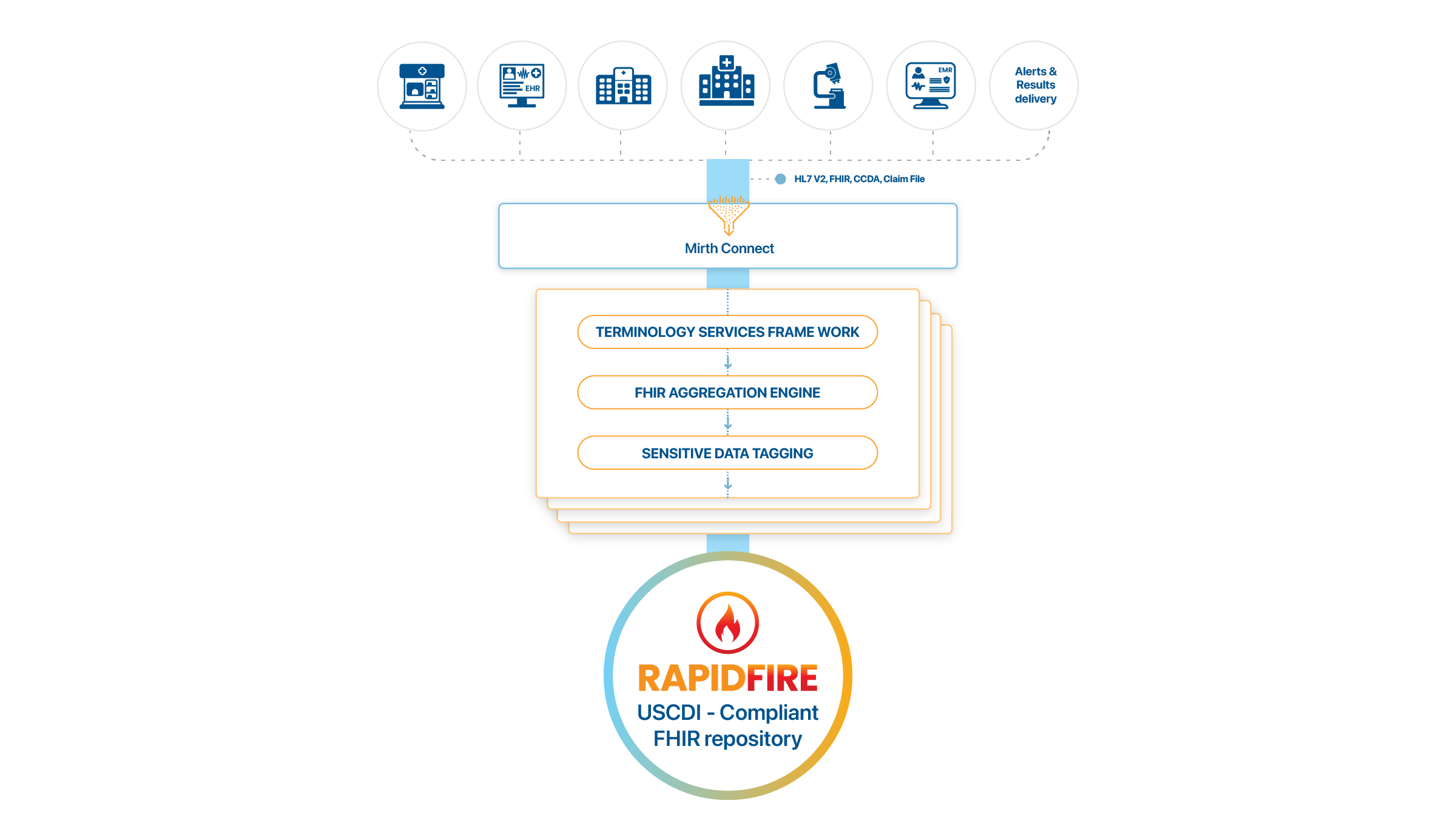
RapidFire’s Big Data Ingestion framework can intake data in a variety of formats and store it in an enhanced FHIR data model, which leverages relational and document storage principles.
Seamless Data Ingestion
Our data ingestion system can ingest different data formats like HL7, CCDA, FHIR, Excel, XML, Claim Files and Custom JSONs and standardize them as advanced FHIR resources. This makes RapidFire a highly versatile and adaptable system enabling it to work with various existing systems such as providers, pharmacies, laboratories, specialty care centers, radiology centers etc.
Two-way functionality
Data ingestion works with API endpoints and hence, data can be read from or input into the server in any desired data format, ensuring pull-push operability. Data can be converted to FHIR resources and can be shared directly from the server for deriving analytics, viewing consolidated records and combining to make reports etc.
Terminology mapper
Healthcare systems should process data in a structured and organized format for data exchange, analysis, quality & research, and clinical decisions. But different sources follow various code systems, making the aggregation of data a complex task.
Thanks to Terminology services, RapidFire maps these values to a standard code. It combines concepts of a particular domain and provides a reference to related terms, definitions, and codes.
Capability to handle increased data volumes
RapidFire’s data processing pipeline is capable of handling any volume of data depending on the data source. It is an effective aggregation engine that aggregates disparate data and pushes it for further processing. Updates and an increase in the volume of data are managed without downtime.
Integration with EMPI
RapidFire is designed to integrate with any EMPI to facilitate rapid implementation and swift integration, enabling a time-effective solution.
Administration and monitoring
Apart from the above features, RapidFire is equipped with comprehensive administration and monitoring capabilities. The processes are entirely tool-driven, leading to an automated, efficient error-free experience and ensure that dependency on IT team is close to none. The monitoring and operation portal provides system monitoring, user access monitoring, log monitoring and ingestion monitoring. Errors occurring can be viewed and corresponding operational tasks can be initiated from the portal.
Accelerate your interoperability transformation with our FHIR services
Aigilx health specializes in developing Interoperability solutions to create a healthcare ecosystem and aids in the delivery of efficient, patient-centric and population-focused healthcare.
This website stores cookies on your computer. These cookies are used to collect information about how you interact with our website and allow us to remember you. We use this information in order to improve and customize your browsing experience and for analytics and metrics about our visitors both on this website and other media. To find out more about the cookies we use, see our Privacy Policy.
If you decline, your information won’t be tracked when you visit this website. A single cookie will be used in your browser to remember your preference not to be tracked.