Epic’s TEFCA Expansion: Lessons from 1000 Hospitals & What’s Next
21 May
Epic’s TEFCA Expansion: Lessons from 1000 Hospitals & What’s Next
Healthcare interoperability is entering a new era. In 2026, the expansion of TEFCA (Trusted Exchange Framework and Common Agreement) across more than 1000 hospitals using Epic represents one of the most significant milestones in nationwide health information exchange.
For years, healthcare organizations struggled with fragmented systems, inconsistent data sharing, and disconnected care experiences. TEFCA aims to change that by creating a standardized framework for secure, nationwide interoperability.
Epic’s growing participation has accelerated adoption at scale, offering healthcare leaders a clearer view into what works, what challenges remain, and what the future of connected care may look like.
This article explores the lessons learned from Epic’s TEFCA expansion, its impact on healthcare operations and patient care, and what organizations should prepare for next.
What Is TEFCA and Why Does It Matter?
TEFCA was created to establish a universal framework for healthcare data exchange across the United States.
Its primary goals include:
- Enabling nationwide interoperability
- Standardizing health information exchange
- Improving patient access to records
- Supporting care coordination
- Reducing information blocking
Rather than relying on isolated regional networks, TEFCA creates a connected ecosystem where organizations can securely exchange patient information across providers, payers, and healthcare systems.
In 2026, interoperability is no longer optional. It is foundational for:
- Value-based care
- Population health management
- Care coordination
- Risk adjustment
- Patient engagement
- Regulatory compliance
Why Epic’s TEFCA Expansion Matters
Epic’s widespread hospital footprint gives its TEFCA participation enormous industry influence.
With more than 1000 hospitals connected through TEFCA-enabled exchange pathways, the healthcare industry is beginning to see interoperability at meaningful scale.
This expansion matters because it:
- Increases nationwide connectivity
- Reduces duplicate testing and administrative friction
- Improves access to longitudinal patient records
- Strengthens referral coordination
- Accelerates real-time data exchange
The shift also demonstrates that interoperability can move beyond isolated pilots into enterprise-wide operational reality.
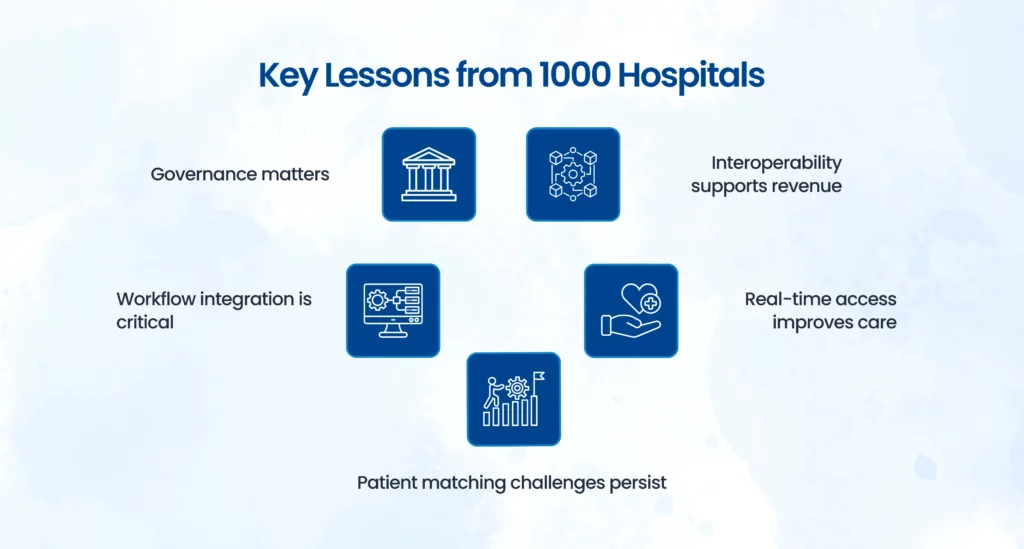
What Lessons Have Emerged from 1000 Hospitals?
1. Interoperability Requires Governance, Not Just Technology
One of the biggest lessons is that interoperability success depends heavily on governance.
Hospitals discovered that simply connecting systems does not guarantee usable exchange. Organizations must also establish:
- Data quality standards
- Identity management policies
- Access controls
- Workflow alignment
- Security protocols
Without governance, exchanged data often becomes inconsistent or difficult to operationalize.
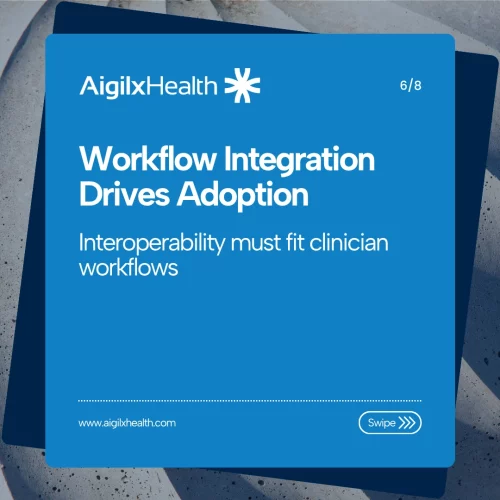
2. Workflow Integration Is Critical
Many hospitals learned that interoperability only creates value when embedded directly into clinical workflows.
If clinicians must leave their EHR environment or manually search for records, adoption drops significantly.
Successful organizations integrated TEFCA-enabled exchange into:
- Admission workflows
- Referral management
- Emergency department access
- Care transitions
- Discharge planning
The lesson is clear: interoperability must feel invisible to end users.
3. Patient Matching Remains a Major Challenge
Even with improved exchange standards, patient identity matching continues to create friction.
Hospitals encountered issues such as:
- Duplicate records
- Inconsistent demographics
- Incomplete patient identifiers
- Cross-network matching errors
Organizations investing in master patient index (MPI) optimization and identity governance achieved better interoperability outcomes.
4. Real-Time Data Access Improves Clinical Decisions
Hospitals participating in TEFCA-enabled exchange reported faster access to:
- Prior diagnoses
- Medication histories
- Lab results
- Imaging reports
- Discharge summaries
This improves:
- Clinical decision-making
- Emergency care coordination
- Duplicate test reduction
- Patient safety
Real-time interoperability transforms data into actionable clinical intelligence.
5. Interoperability Supports Financial Performance
Beyond clinical benefits, organizations are seeing measurable operational improvements.
Hospitals report gains in:
- Referral retention
- Revenue capture
- Reduced denials
- Faster authorization workflows
- Lower administrative burden
Connected data exchange improves both care delivery and financial sustainability.
How Is TEFCA Changing Healthcare Operations?
TEFCA is shifting interoperability from isolated exchange to enterprise-wide connectivity.
1. Stronger Cross-Organization Collaboration
Providers can exchange information more efficiently across:
- Hospitals
- Specialists
- Primary care networks
- Behavioral health organizations
- Post-acute facilities
This creates more coordinated patient journeys.
2. Reduced Administrative Friction
Automated exchange reduces reliance on:
- Fax-based workflows
- Manual records requests
- Phone-based coordination
- Repetitive documentation
Operational efficiency improves substantially when data flows automatically.
3. Better Support for Value-Based Care
Value-based reimbursement models depend on longitudinal patient visibility.
TEFCA improves access to:
- Quality metrics
- Care gap information
- Risk adjustment data
- Utilization trends
Organizations gain a more complete picture of patient outcomes across networks.
What Role Does FHIR Play in TEFCA Expansion?
FHIR (Fast Healthcare Interoperability Resources) continues to play a major role in modern interoperability.
FHIR enables:
- API-based connectivity
- Real-time exchange
- Standardized data structures
- Scalable integrations
- Faster application development
As TEFCA adoption grows, FHIR-based APIs are becoming increasingly important for:
- Patient access applications
- Referral workflows
- Clinical decision support
- Population health analytics
FHIR helps transform interoperability from static exchange into dynamic ecosystem connectivity.
Despite progress, several barriers remain.
1. Data Normalization Issues
Different organizations still use varying:
- Coding systems
- Documentation standards
- Clinical terminologies
Normalization remains essential for accurate analytics and care coordination.
2. Security and Consent Complexity
As exchange networks grow, organizations must strengthen:
- Cybersecurity controls
- Consent management
- Access auditing
- Compliance monitoring
Balancing accessibility with security remains critical.
3. Operational Readiness Gaps
Some organizations still lack:
- Interoperability expertise
- Dedicated governance teams
- Scalable infrastructure
- Workflow optimization strategies
Technology alone cannot solve organizational readiness challenges.
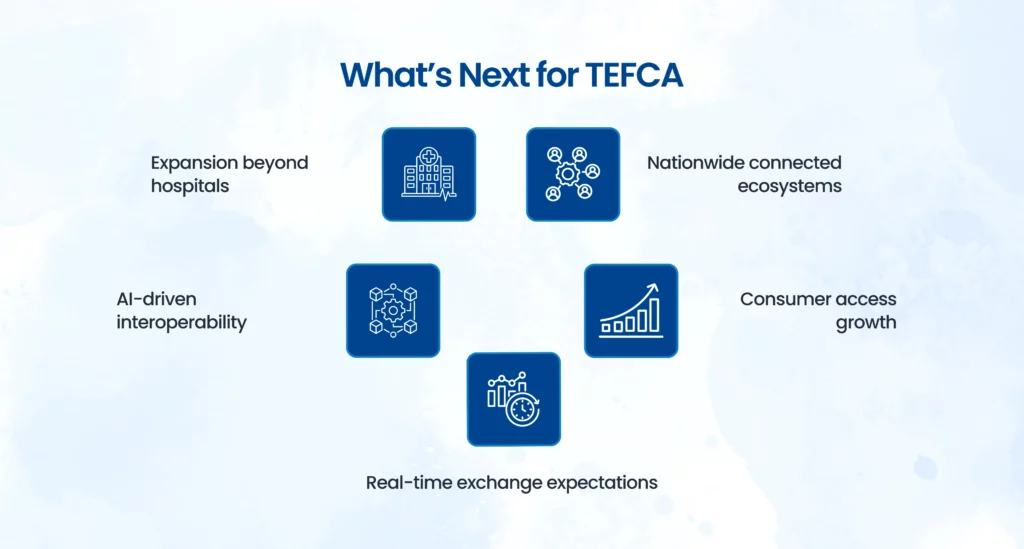
What’s Next for TEFCA in 2026 and Beyond?
The next phase of TEFCA expansion will likely focus on deeper ecosystem connectivity.
Key trends include:
1. Expansion Beyond Hospitals
Interoperability will increasingly include:
- Behavioral health
- Long-term care
- Home health
- Payers
- Public health agencies
The network will become more comprehensive across the care continuum.
2. Greater Patient Access
Patients will gain more seamless access to:
- Unified health records
- Cross-provider data
- Digital health applications
- Care coordination tools
Consumer-driven interoperability will continue expanding.
3. AI-Driven Interoperability Insights
Healthcare organizations will begin using AI to:
- Detect care gaps
- Predict referral leakage
- Identify documentation issues
- Improve workflow automation
- Enhance population health strategies
Connected data creates the foundation for advanced healthcare intelligence.
4. More Real-Time Exchange Expectations
Healthcare leaders will increasingly expect:
- Instant clinical access
- Real-time notifications
- Automated workflows
- Predictive operational insights
Static exchange models will no longer meet operational demands.
How Can Healthcare Organizations Prepare?
1. Invest in Interoperability Governance
Establish enterprise-wide frameworks for:
- Data quality
- Identity management
- Security
- Workflow standardization
2. Adopt FHIR-First Architectures
API-driven interoperability will become essential for scalable exchange.
Organizations should modernize legacy integration strategies.
3. Strengthen Data Normalization
Consistent data standards improve:
- Analytics accuracy
- Clinical usability
- Reporting performance
- AI readiness
4. Optimize Workflow Integration
Interoperability should support clinicians without increasing administrative burden.
Workflow-centered design is critical for adoption.
5. Prepare for Nationwide Connectivity
Healthcare organizations should assume that nationwide exchange will continue expanding rapidly.
Future-ready infrastructure is becoming a competitive necessity.
How Aigilx Health Supports TEFCA Readiness
Aigilx Health helps healthcare organizations strengthen interoperability through:
- FHIR integration strategies
- EHR interoperability optimization
- Data normalization and governance
- Workflow automation
- Referral and care coordination optimization
- Analytics and operational visibility
By aligning technology, governance, and workflows, Aigilx Health helps organizations maximize the value of connected healthcare ecosystems.
Why Epic’s TEFCA Expansion Signals a Turning Point
Epic’s expansion across 1000 hospitals demonstrates that nationwide interoperability is no longer theoretical.
The industry is moving toward:
- Real-time data exchange
- Cross-network collaboration
- Connected patient journeys
- Enterprise interoperability strategies
Healthcare organizations that modernize early will be better positioned to:
- Improve patient outcomes
- Reduce operational inefficiencies
- Strengthen financial performance
- Succeed in value-based care models
The future of healthcare depends on connected, interoperable ecosystems.
How Can Organizations Move Forward with Confidence?
The path forward requires healthcare leaders to:
- Break down data silos
- Prioritize interoperability governance
- Embrace FHIR-based exchange
- Optimize operational workflows
- Build scalable integration strategies
Organizations that treat interoperability as a strategic capability rather than a compliance requirement will gain long-term operational and financial advantages.
FAQs
TEFCA (Trusted Exchange Framework and Common Agreement) is a nationwide interoperability framework designed to standardize secure health information exchange across healthcare organizations.
Epic’s participation accelerates large-scale interoperability adoption, enabling connected data exchange across more than 1000 hospitals.
TEFCA enables providers to access patient information more quickly, improving care coordination, reducing delays, and supporting better clinical decisions.
FHIR enables standardized, API-based data exchange that supports real-time interoperability across healthcare systems.
Key challenges include patient matching, data normalization, workflow integration, cybersecurity, and organizational readiness.
Aigilx Health supports interoperability strategy, FHIR integration, workflow optimization, governance, and connected data exchange initiatives.
Categories
- 1115 Waiver (8)
- ACO (7)
- AI (48)
- Aigilx Health (48)
- CCBHC (8)
- Control Center (10)
- FHIR Facade (7)
- FHIR Server (14)
- HIE (5)
- Payers (8)
- Providers (11)
- Rapid Fire (9)

ISO 27001:2022 Certified
Aigilx health specializes in developing Interoperability solutions to create a healthcare ecosystem and aids in the delivery of efficient, patient-centric and population-focused healthcare.