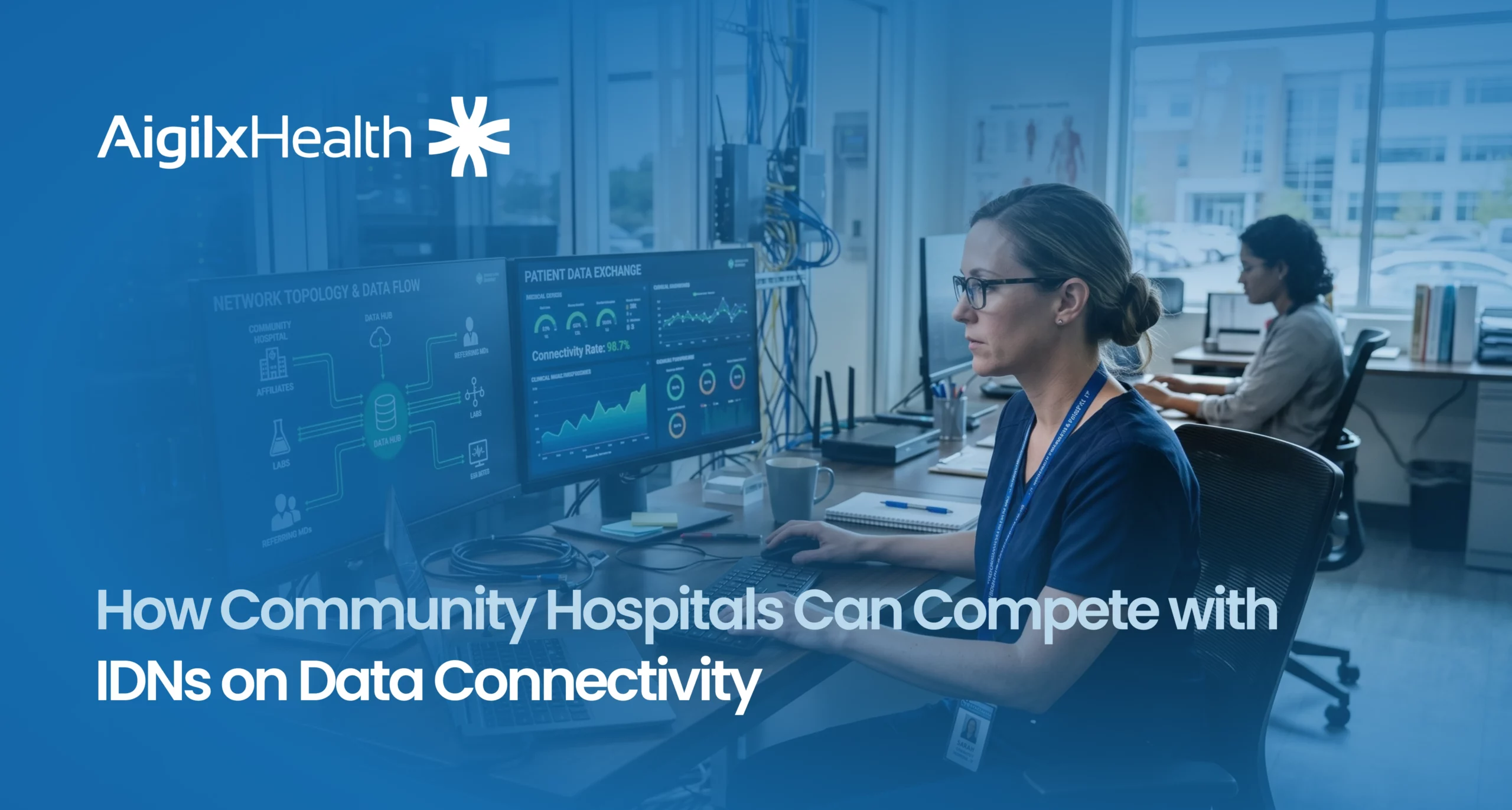
How Community Hospitals Can Compete with IDNs on Data Connectivity
29 Apr
How Community Hospitals Can Compete with IDNs on Data Connectivity
In 2026, data connectivity has become a defining factor in healthcare competitiveness. Integrated Delivery Networks (IDNs) have long held an advantage due to their scale, centralized systems, and robust IT investments. However, community hospitals are increasingly under pressure to deliver the same level of seamless data exchange, care coordination, and patient experience without comparable resources.
With regulatory mandates such as the 21st Century Cures Act, the adoption of FHIR-based APIs, and the rise of frameworks like TEFCA, the expectation for real-time, interoperable data exchange is no longer optional.
The challenge is clear: how can community hospitals compete with IDNs on data connectivity without the same infrastructure or budgets?
This article explores the barriers community hospitals face, the strategic opportunities available, and how organizations can leverage modern interoperability approaches along with partners like Aigilx Health to level the playing field.
Why do IDNs have an advantage in data connectivity?
IDNs operate with structural and technological advantages that make data connectivity easier to achieve and scale.
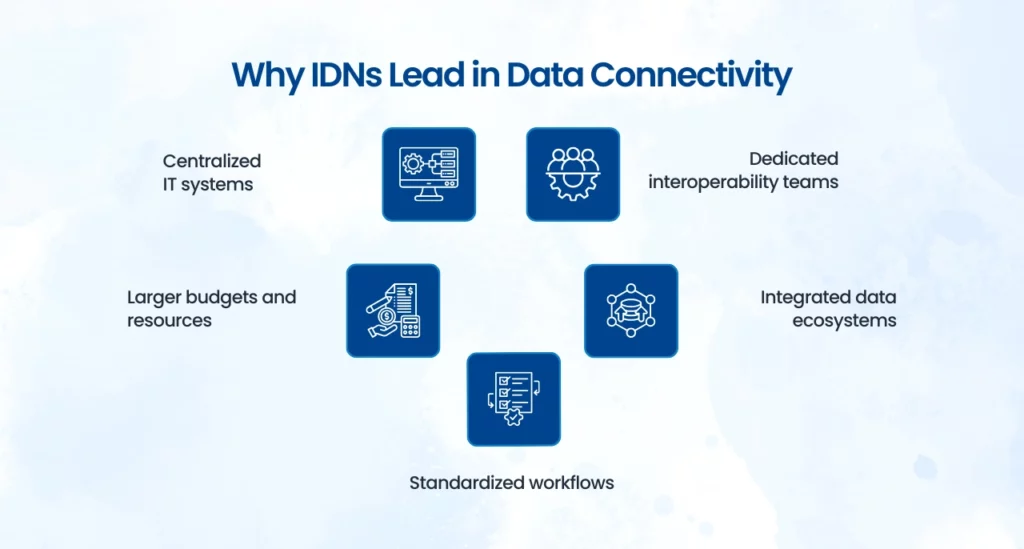
1. Centralized IT Infrastructure
IDNs typically operate on unified EHR platforms and centralized IT governance, enabling consistent data standards and seamless internal data exchange.
2. Larger Technology Budgets
With greater financial resources, IDNs can invest in advanced interoperability platforms, analytics tools, and integration teams.
3. Standardized Workflows Across Facilities
Standardization across hospitals, clinics, and care settings allows IDNs to maintain consistent data capture and exchange practices.
4. Dedicated Interoperability Teams
IDNs often have specialized teams focused on integration, compliance, and data governance.
For community hospitals, these advantages can feel difficult to match—but they are not impossible to overcome.
What challenges do community hospitals face in data connectivity?
Community hospitals face a unique set of constraints that impact interoperability and data exchange.
1. Limited IT Resources
Smaller teams often manage multiple priorities, leaving limited bandwidth for complex interoperability initiatives.
2. Fragmented EHR Ecosystems
Many community hospitals rely on multiple systems, including platforms like MEDITECH or eClinicalWorks, along with third-party applications, creating integration complexity.
3. Legacy Infrastructure
Older systems may not fully support modern API-based interoperability, requiring additional effort to integrate.
4. Budget Constraints
Capital limitations make it difficult to invest in large-scale IT transformations.
5. Governance and Standardization Gaps
Without centralized governance, inconsistencies in data standards and workflows can hinder interoperability.
These challenges can create data silos, delay decision-making, and impact patient outcomes.
Why is data connectivity critical for community hospitals today?
Data connectivity is no longer just a technical capability it is a strategic necessity.
Community hospitals must compete on:
- Patient experience and access to information
- Care coordination across providers
- Value-based care performance
- Regulatory compliance
- Operational efficiency
Without strong data connectivity, community hospitals risk falling behind IDNs in both clinical outcomes and financial performance.
How can community hospitals compete with IDNs on data connectivity?
The key is not to replicate IDN infrastructure but to adopt smarter, more scalable strategies.
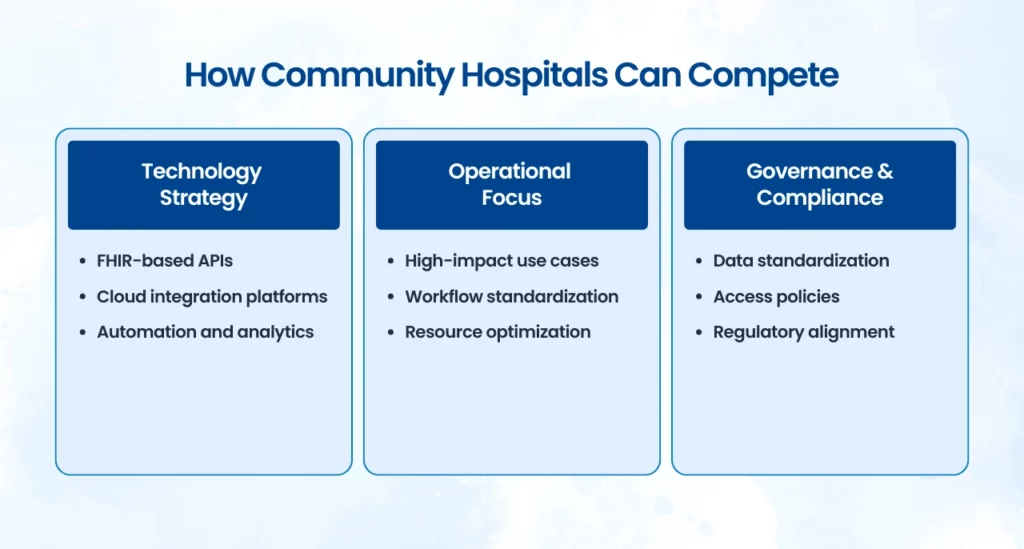
1. Adopt a FHIR-First Integration Strategy
FHIR-based APIs enable real-time, standardized data exchange without the need for complex custom interfaces.
2. Leverage Interoperability Platforms
Cloud-based integration platforms can connect disparate systems, reducing the need for large internal IT teams.
3. Participate in TEFCA and HIEs
Engaging with national frameworks and Health Information Exchanges expands connectivity beyond organizational boundaries.
4. Prioritize High-Impact Use Cases
Focus on areas that deliver immediate value, such as:
- Care transitions
- Patient access
- Referral management
- Quality reporting
5. Standardize Data and Workflows
Implementing consistent data standards improves interoperability and reduces downstream inefficiencies.
6. Partner with Interoperability Experts
Collaborating with experts like Aigilx Health allows community hospitals to accelerate implementation without large internal investments.
What role does technology play in leveling the playing field?
Modern technology enables community hospitals to compete more effectively with IDNs.
Key capabilities include:
- API-driven integration for real-time data exchange
- Cloud-based platforms for scalability
- Automation to reduce manual workflows
- Analytics for population health and performance tracking
- Secure data-sharing frameworks
These technologies reduce reliance on legacy infrastructure and enable faster, more efficient interoperability.
Why is governance just as important as technology?
Technology alone cannot solve interoperability challenges.
Strong governance ensures:
- Consistent data standards
- Clear access policies
- Compliance with regulatory requirements
- Alignment across departments
Community hospitals that prioritize governance alongside technology can achieve sustainable, scalable interoperability.
How Aigilx Health Helps Community Hospitals Compete
Aigilx Health supports community hospitals by:
- Enabling FHIR and HL7-based integrations
- Optimizing EHR systems and workflows
- Supporting TEFCA and regulatory readiness
- Implementing scalable interoperability platforms
- Strengthening data governance frameworks
By combining technology, expertise, and strategic guidance, Aigilx Health helps community hospitals achieve IDN-level connectivity without IDN-level complexity.
How can you move forward with confidence?
Competing with IDNs on data connectivity is not about matching their scale—it is about leveraging smarter strategies.
With the right approach, community hospitals can:
- Break down data silos
- Improve patient care and coordination
- Meet regulatory requirements
- Enhance operational efficiency
- Drive measurable ROI
Interoperability is no longer a barrier it is an opportunity to compete, differentiate, and grow.
FAQs
Information blocking refers to practices that prevent or delay access to electronic health information, violating ONC regulations unless a valid exception applies.
Limited IT resources, fragmented systems, and lack of standardized governance are the most common challenges.
FHIR enables standardized, API-based data exchange, reducing integration complexity and improving scalability.
They expand connectivity across organizations, enabling broader data exchange beyond individual hospital systems.
By focusing on high-impact use cases such as patient access, care coordination, and regulatory compliance.
Aigilx Health provides interoperability consulting, integration solutions, and governance frameworks to help community hospitals compete effectively.
Categories
- 1115 Waiver (8)
- ACO (7)
- AI (48)
- Aigilx Health (48)
- CCBHC (8)
- Control Center (10)
- FHIR Facade (7)
- FHIR Server (14)
- HIE (5)
- Payers (8)
- Providers (11)
- Rapid Fire (9)

ISO 27001:2022 Certified
Aigilx health specializes in developing Interoperability solutions to create a healthcare ecosystem and aids in the delivery of efficient, patient-centric and population-focused healthcare.