7 common HL7-to-FHIR mapping mistakes that delay interoperability projects
24 Jul

Key takeaways
- Most HL7-to-FHIR mapping mistakes produce technically valid FHIR resources that still fail to work correctly once a downstream system tries to use them.
- Assuming a clean one-to-one relationship between HL7v2 segments and FHIR resources breaks down for anything beyond the simplest message types.
- FHIR resources that pass base specification validation can still fail US Core profile conformance, which is what most real-world consumers and certification programs actually require.
- Null values, negative results, and missing data need explicit handling in FHIR. Silently dropping them changes their clinical meaning.
- Broken references between resources, a Condition that does not correctly link to its Patient or Encounter, make data technically present but practically unusable.
- Date and time conversion between HL7v2 and FHIR formats is a common, quiet source of clinical errors when timezone handling is not addressed directly.
- Terminology mapping is ongoing maintenance work, not a task a project closes out at go-live.
A mapping project usually starts with confidence. The team knows HL7v2, they know FHIR is the target, and the HL7-to-FHIR mapping looks straightforward on a whiteboard. Then the project runs long, not because the mapping was wrong exactly, but because it was incomplete in ways nobody caught during testing.
Most delays in these interoperability projects trace back to a small set of recurring mistakes, and they show up across teams with very different levels of experience. None of them are exotic. They are mistakes that pass a basic validation check and only surface once a downstream system tries to actually use the data.
This piece walks through seven of the most common ones, why each causes real delay rather than a quick fix, and what catches them before they show up in production.
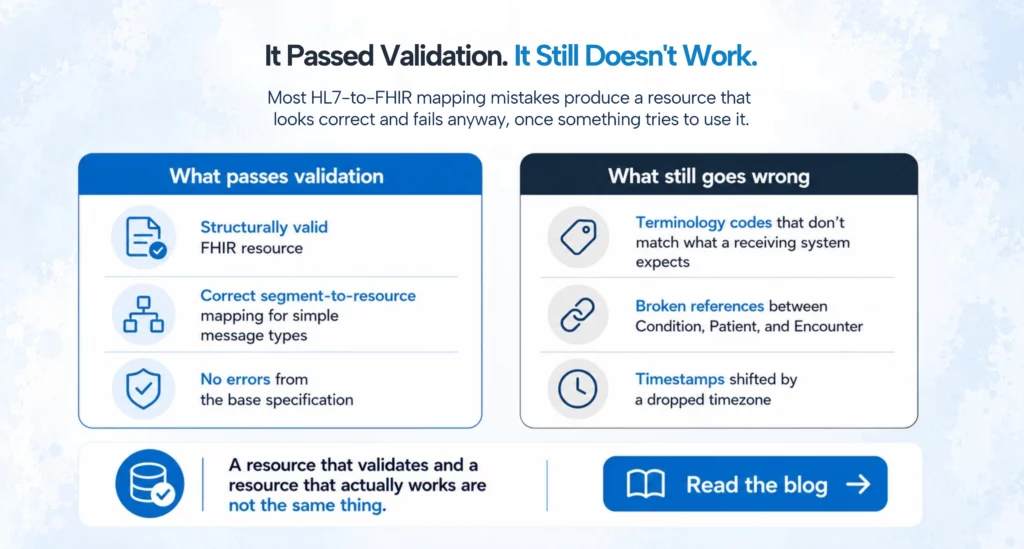
Table of contents
Why do mapping mistakes cause delays instead of quick fixes?
A mapping error rarely shows up as an obvious failure. The message converts, the FHIR resource validates against the base specification, and the interface appears to be working. The problem only becomes visible when a downstream system, an analytics platform, a decision support tool, a second EHR, tries to actually use that data and gets something wrong or nothing at all.
That delay between deployment and discovery is what turns a mapping mistake into a project delay instead of a quick patch. By the time the issue surfaces, it is often buried in a live interface handling real patient data, which makes the fix slower and the testing around it more cautious.
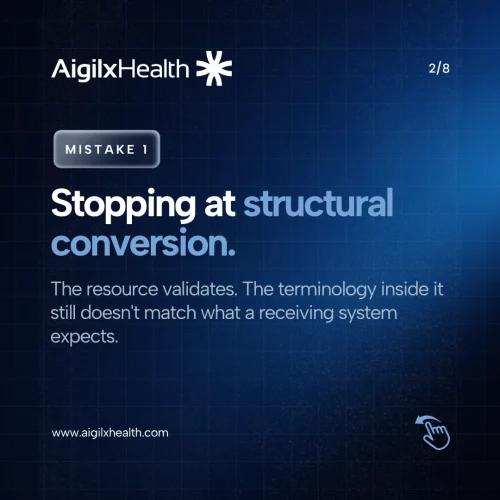
Mistake 1: Treating structural conversion as complete integration
Mapping an HL7v2 OBX segment to a FHIR Observation resource is a real, necessary step. It is also only the structural half of the work. The clinical code inside that segment still has to align with what the receiving system expects, usually LOINC for lab results.
Teams that stop once the resource validates structurally often discover the gap only when a payer’s analytics platform or a population health tool starts returning results that do not match across sites, because the underlying codes were never standardized in the conversion.
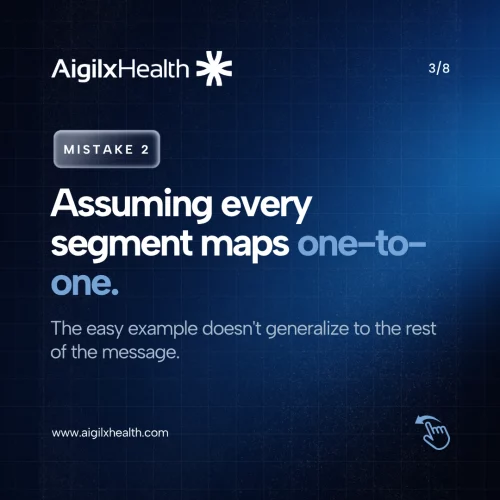
Mistake 2: Assuming a one-to-one mapping between segments and resources
A PID segment maps cleanly to a FHIR Patient resource, and that clean example sets an expectation that does not hold for the rest of the message. An NK1 segment describing next of kin, for instance, maps to a RelatedPerson resource, a separate resource type entirely, not a field inside Patient.
Some segments map to multiple resources. Some information spread across several segments needs to be combined into a single resource. Treating the whole mapping exercise as a repeatable one-to-one pattern leads to a design that works for the easy segments and breaks down everywhere else.
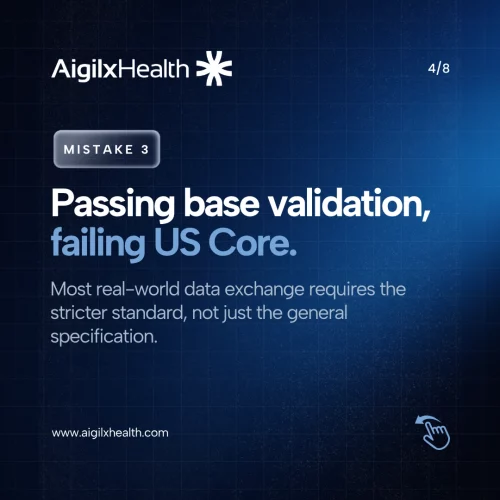
Mistake 3: Ignoring FHIR implementation guides and profiles
Base FHIR validation confirms a resource follows the general specification. It does not confirm the resource meets US Core, the implementation guide most US health data exchange actually requires, including the profiles built into ONC certification requirements.
A resource can pass base validation and still be missing a required US Core extension, use the wrong terminology binding, or omit a field a real consuming system expects as mandatory. The 2025 State of FHIR survey, conducted by HL7 International and Firely, specifically flagged inconsistent implementation across institutions as an ongoing barrier, and profile conformance gaps are a large part of what that inconsistency looks like in practice.
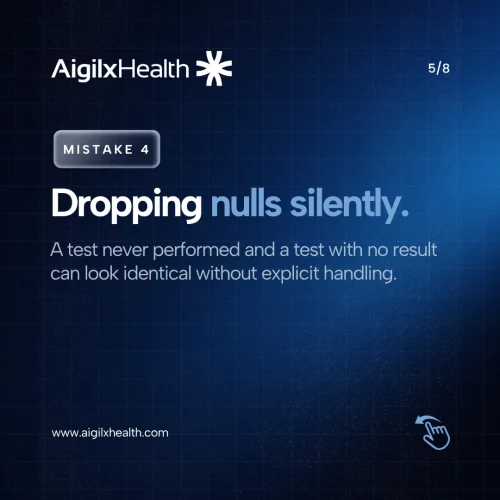
Mistake 4: Mishandling null values and negative results
HL7v2 has specific conventions for representing missing data, negative test results, and information that was never collected at all, often through null flavors and specific field codes. FHIR requires its own explicit mechanisms, like data-absent-reason extensions, to represent the same concepts.
Dropping a null value silently during conversion, rather than mapping it to its FHIR equivalent, can turn “this test was not performed” into a resource that simply has no data at all, which a downstream system may misread as the test never having been ordered.
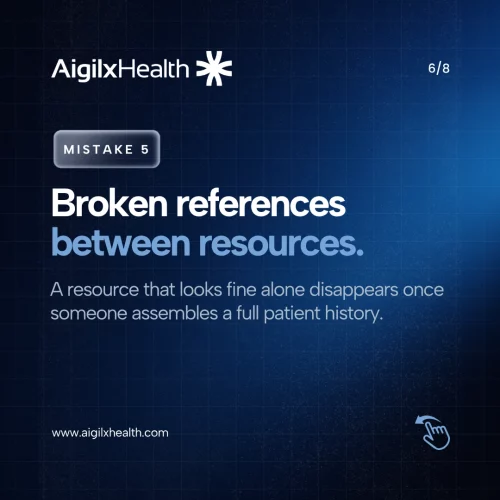
Mistake 5: Breaking referential integrity between resources
FHIR resources are meant to reference each other. A Condition resource should reference the Patient it belongs to and often the Encounter it was diagnosed during. When those references are mapped incorrectly, or point to the wrong identifier, the resource still validates on its own but becomes disconnected from the patient record it was supposed to describe.
This kind of error is particularly easy to miss in testing, because the resource looks complete in isolation. It only becomes visible when a system tries to pull a patient’s full Condition history and finds gaps or duplicates caused by broken links.
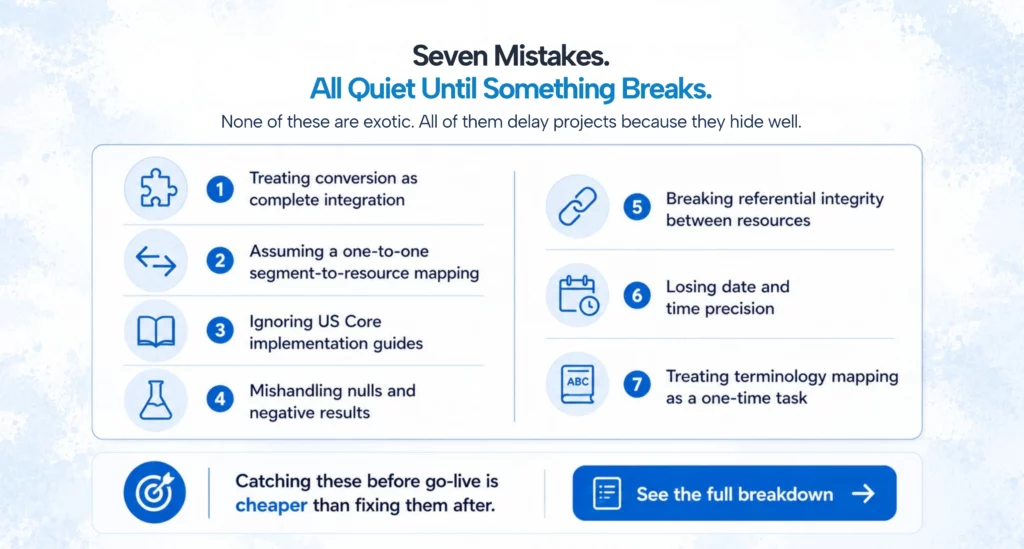
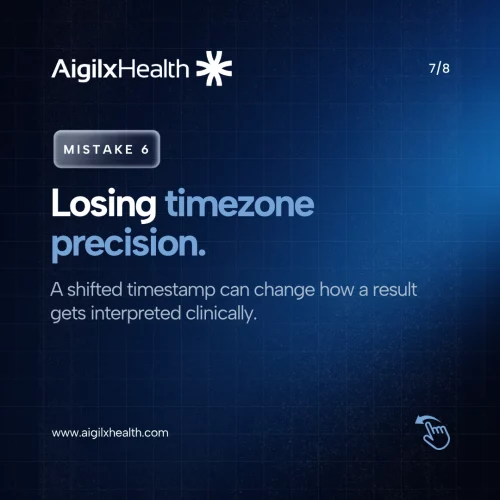
Mistake 6: Losing date and time precision during conversion
HL7v2 timestamp formats and FHIR’s dateTime format handle precision and timezone information differently. A conversion that does not explicitly account for this can shift a timestamp by hours, or silently drop timezone context that a receiving system needs to display the correct local time.
This kind of error is quiet and clinically significant at the same time. A lab result that appears to have been drawn at the wrong time, even by a few hours, can affect how a clinician interprets it relative to a treatment or medication timeline.
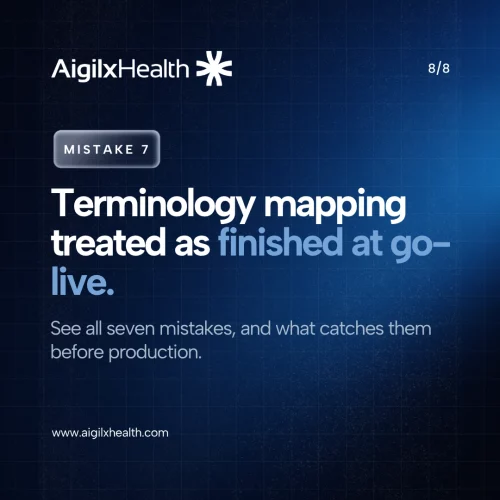
Mistake 7: Treating terminology mapping as a one-time task
LOINC, SNOMED CT, and RxNorm are each maintained separately, on independent release schedules, through organizations like the Regenstrief Institute and the National Library of Medicine. A mapping table built once at project launch will drift out of alignment as these standards update, even if nothing else about the interface changes.
Teams that treat mapping as a deliverable to close out at go-live, rather than an ongoing responsibility with a named owner, tend to see mapping accuracy degrade quietly over months, resurfacing as a data quality issue long after the project was considered finished.
The seven mistakes at a glance
Common mapping mistakes and what they actually cause
Mistake | What it looks like | What it actually causes |
Treating conversion as complete | FHIR resource validates structurally | Terminology mismatches that break downstream analytics |
Assuming one-to-one mapping | Simple segments mapped correctly, complex ones ignored | Missing or malformed resources for anything beyond basic message types |
Ignoring implementation guides | Base FHIR validation passes | US Core profile failures that block real-world data exchange |
Mishandling nulls and negatives | Missing data dropped silently | Test-not-performed misread as test-never-ordered |
Breaking referential integrity | Resource looks complete in isolation | Disconnected records when systems try to assemble a full patient history |
Losing date and time precision | Timestamp conversion looks fine at a glance | Clinically significant timing errors in patient records |
Treating terminology mapping as one-time | Mapping table accurate at launch | Silent accuracy drift as standards update independently |
What should teams do differently from the start?
- Test against US Core profiles, not just base FHIR validation, since that is the standard most real consumers and certification programs actually check.
- Map segment by segment, not as a template, since complex HL7v2 message types rarely follow the same pattern as the simplest ones.
- Build explicit handling for null values and negative results, rather than letting them fall through silently during conversion.
- Validate referential integrity as its own test, checking that every resource links correctly to the patient and encounter it belongs to.
- Confirm timezone and precision handling explicitly, rather than assuming a date conversion library handles it correctly by default.
- Assign ownership of terminology mapping tables, treating them as a maintained asset rather than a project deliverable that ends at go-live.
FAQs
Most of them produce a FHIR resource that is technically valid on its own. The problem only appears when a downstream system tries to use the data for something specific, like matching a terminology code or assembling a full patient record.
Base validation checks that a resource follows the general FHIR specification. US Core conformance checks that it meets the specific profiles most US health data exchange and certification programs actually require, which is a stricter and more practical standard.
Very common in early-stage mapping projects, since the simplest segments, like PID to Patient, genuinely do map cleanly and create a false expectation for the rest of the message.
A shifted timestamp can change how a clinician interprets a lab result or medication timing relative to other events in the patient's record, even when the shift is only a few hours.
A specific person or team, not a shared responsibility with no clear owner. LOINC, SNOMED CT, and RxNorm each update independently, and mapping drift happens quietly without dedicated upkeep.
Most of them, yes, if testing specifically checks for US Core conformance, referential integrity, and terminology accuracy rather than only confirming the resource validates structurally.
Categories
- 1115 Waiver (8)
- ACO (7)
- AI (40)
- Aigilx Health (40)
- CCBHC (8)
- Control Center (10)
- FHIR Facade (7)
- FHIR Server (14)
- HIE (5)
- Payers (8)
- Providers (11)
- Rapid Fire (9)

ISO 27001:2022 Certified
Aigilx health specializes in developing Interoperability solutions to create a healthcare ecosystem and aids in the delivery of efficient, patient-centric and population-focused healthcare.