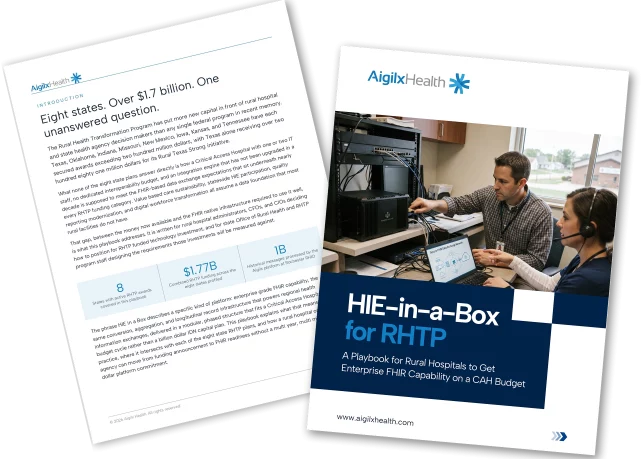
HIE-in-a-Box for RHTP
A playbook for rural hospitals to get enterprise FHIR capability on a Critical Access Hospital budget. Original Aigilx analysis of $1.77 billion in RHTP funding across eight states, with a proprietary scoring framework for where the opportunity is real right now.
Inside This Playbook
Eight states have answered the funding question.The technology question is still open.
Every RHTP state plan depends, explicitly or implicitly, on rural hospitals having standardized, FHIR-native clinical data they do not currently have. Rather than walking through eight separate state programs, this playbook introduces two original Aigilx scoring frameworks, the Interoperability Exposure Index and the Phase 1 Fit Score, that map exactly where the near-term opportunity sits, backed by a platform already proven at genuine regional HIE scale.
What this playbook covers
02
Why rural hospitals cannot solve this the way mid-level hospitals do: the CAH Constraint Stack
03
What HIE-in-a-Box actually means: the five capabilities that define the model
04
Proven at HIE scale: the Rochester RHIO deployment and what it means at CAH scale
05
The Aigilx Phase 1 Fit Score: which states match a modular, 60 to 90 day deployment right now
06
The three-phase deployment model built for rural hospital budget cycles
07
Constraint-based capability table: what HIE-in-a-Box solves for rural hospitals specifically
Get the Free eBook
For Venture Funded AI Startup Leaders
By submitting you agree to our privacy policy. We never sell your data.
Key Takeaways
What rural hospital and state agency leaders walk away knowing
RHTP removes the capital barrier, not the staffing barrier
RHTP funding solves the historical absence of capital for rural FHIR modernization. It does nothing to solve the staffing and timeline constraints of a CAH with one or two total IT staff. The technology model still has to be built for that reality.
Modularity is not optional at CAH scale
A mid-level hospital choosing a phased deployment is choosing convenience. A Critical Access Hospital choosing the same model is choosing between modernization and no modernization at all, because an enterprise-priced platform is simply not executable within CAH constraints.
Funding size and technology readiness are not correlated
The state with the largest single award is not the state closest to a deployable technology opportunity. Reading both independently, using the Exposure Index and the Phase 1 Fit Score together, is the only way to find where real near-term opportunity exists.
A platform proven at HIE scale is not stretched by a single hospital
The conversion and aggregation technology that processes 550,000+ messages a day for a regional HIE is not a smaller-fit problem for a 25-bed CAH. A single facility deployment is a narrower, more contained version of a problem already solved at far greater scale.
Regional coalition structures are a natural fit for shared deployment
A single FHIR-native CDR can serve every member of a regional coalition or multi-facility grant structure simultaneously, achieving shared standardized data at a lower per-facility cost than separate individual deployments.
Phase 1 is fundable inside a single grant cycle
HL7 and C-CDA conversion plus an initial FHIR-native CDR is scoped as a defined engagement with a defined price, sized to fit within a typical state grant performance period rather than a multi-year capital plan.
Who This Is For
Written for both sides of the RHTP funding conversation
CAH Administrators and CEOs
Positioning their facility for RHTP-funded technology investment without a dedicated interoperability team or a multi-year capital plan to support a large platform commitment.
Rural Hospital CFOs and CIOs
Evaluating modular pricing and phased deployment against the realities of a single fiscal year capital allocation and a one or two person IT team.
State Offices of Rural Health
Designing RFI and RFP language for RHTP technology investment that needs to work for the full population of rural facilities, not just the largest and best resourced ones.
Regional Coalition and State HIE Leaders
Evaluating whether a shared FHIR-native deployment can serve multiple member facilities or the entire state network through a single platform investment.
Request a FHIR Readiness Assessment scoped to your state's RHTP funding category
Delivered by Aigilx interoperability architects. No commitment required.

ISO 27001:2022 Certified
Aigilx health specializes in developing Interoperability solutions to create a healthcare ecosystem and aids in the delivery of efficient, patient-centric and population-focused healthcare.