What Is FHIR? Why Rural Hospitals Can’t Ignore It in 2026
03 Jun
What Is FHIR? Why Rural Hospitals Can’t Afford to Ignore It in 2026
Rural hospitals across the United States are facing growing operational, financial, and regulatory pressure in 2026. Rising patient demands, staffing shortages, reimbursement challenges, and evolving federal interoperability requirements are forcing healthcare organizations to modernize faster than ever before.
At the center of this transformation is FHIR (Fast Healthcare Interoperability Resources).
For many rural healthcare leaders, interoperability still feels like a highly technical IT initiative. However, in 2026, FHIR has become much more than a technology standard. It is now directly connected to healthcare compliance, reimbursement readiness, patient care coordination, and long-term operational sustainability.
Federal healthcare initiatives, CMS interoperability mandates, and Rural Health Transformation Program (RHTP) modernization efforts are all increasing the urgency for rural hospitals to strengthen their interoperability capabilities.
Hospitals operating with disconnected systems, outdated integrations, and fragmented patient records risk falling behind in both compliance and patient care delivery.
FHIR offers rural hospitals a scalable way to modernize healthcare systems without requiring complete infrastructure replacement.
For Critical Access Hospitals (CAHs), rural health networks, and community healthcare providers, interoperability is no longer optional. It is becoming foundational to future-ready healthcare operations.
What Is FHIR in Simple Terms?
FHIR stands for Fast Healthcare Interoperability Resources.It is a modern healthcare interoperability standard designed to help healthcare systems exchange patient data securely, efficiently, and in real time.
Unlike older healthcare integration methods that rely heavily on custom interfaces and manual workflows, FHIR uses API-based communication similar to modern consumer applications.
FHIR enables healthcare systems to securely share:
- Patient records
- Lab results
- Medication histories
- Care plans
- Referral information
- Imaging data
- Claims and billing information
- Social determinants of health (SDOH) data
In simple terms, FHIR helps different healthcare technologies “talk” to each other more effectively.
For rural hospitals that often rely on multiple disconnected systems, FHIR creates a more connected healthcare environment.
Why Interoperability Matters in Rural Healthcare?
Rural healthcare organizations operate within highly complex care ecosystems.
Patients frequently receive care from:
- Critical Access Hospitals
- Regional health systems
- Primary care clinics
- Behavioral health providers
- Specialty providers
- Emergency departments
- Telehealth networks
- Community health organizations
Without interoperability, these systems often fail to exchange information efficiently.
This creates several operational and clinical problems, including:
- Delayed care coordination
- Duplicate testing
- Incomplete patient histories
- Manual referral workflows
- Administrative inefficiencies
- Limited visibility into patient outcomes
- Increased clinician burden
- Poor patient experience
In rural healthcare environments where resources are already limited, disconnected systems can significantly impact operational performance and patient outcomes.
FHIR helps reduce these challenges by enabling standardized, real-time healthcare data exchange.
Why Rural Hospitals Face Unique Interoperability Challenges?
Rural healthcare organizations often face greater technology limitations than large urban health systems.
Common rural hospital interoperability gaps include:
1. Legacy EHR Infrastructure
Many rural hospitals still operate older EHR systems with limited API support and outdated integration capabilities.
2. Budget Constraints
Technology modernization initiatives are often delayed due to financial pressures and limited IT budgets.
3. Limited Internal IT Resources
Small healthcare organizations may not have dedicated interoperability teams or in-house FHIR expertise.
4. Fragmented Vendor Ecosystems
Rural hospitals frequently use multiple disconnected healthcare applications across departments.
5. Manual Data Exchange Processes
Fax-based referrals, spreadsheets, and manual workflows continue to create inefficiencies.
6. Compliance Complexity
Federal interoperability requirements continue to evolve, increasing operational risk for hospitals that are not prepared.
FHIR helps healthcare organizations modernize incrementally rather than requiring complete infrastructure replacement.
Why CMS Is Increasing Pressure Around Interoperability?
In 2026, healthcare interoperability is becoming closely tied to compliance, reimbursement, and digital transformation initiatives.
CMS interoperability policies increasingly focus on:
- Real-time patient access to healthcare data
- API-enabled healthcare systems
- Secure healthcare data exchange
- Improved care coordination
- Patient-centered healthcare delivery
- Standardized healthcare information sharing
Healthcare organizations that fail to modernize interoperability capabilities may face growing compliance and operational challenges. For rural hospitals, these pressures are amplified because many organizations still operate within fragmented healthcare environments.FHIR readiness is quickly becoming essential for long-term healthcare modernization.
Understanding FHIR R4 Compliance in 2026
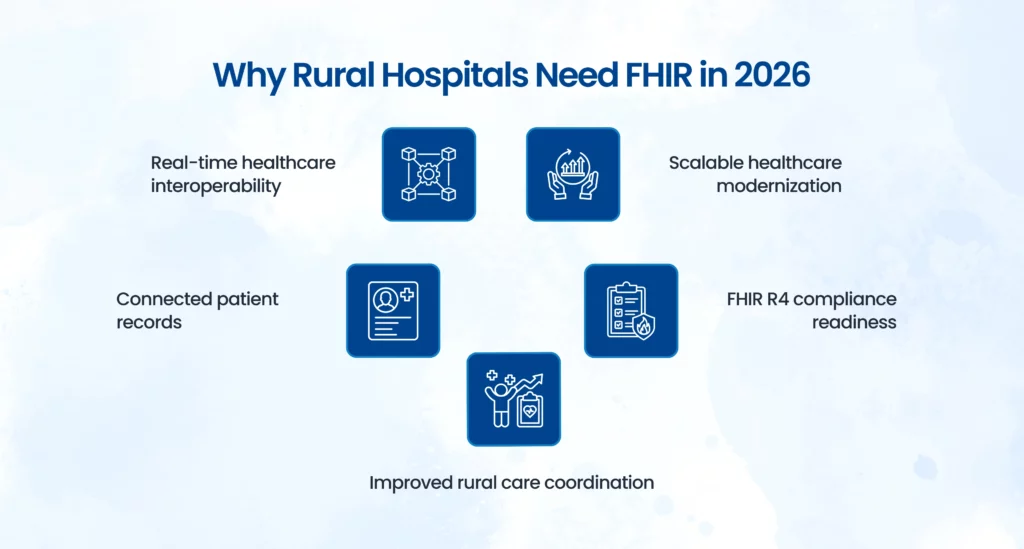
FHIR R4 (Release 4) has become one of the most widely adopted interoperability standards across healthcare ecosystems.
FHIR R4 supports:
- Standardized APIs
- Structured healthcare data exchange
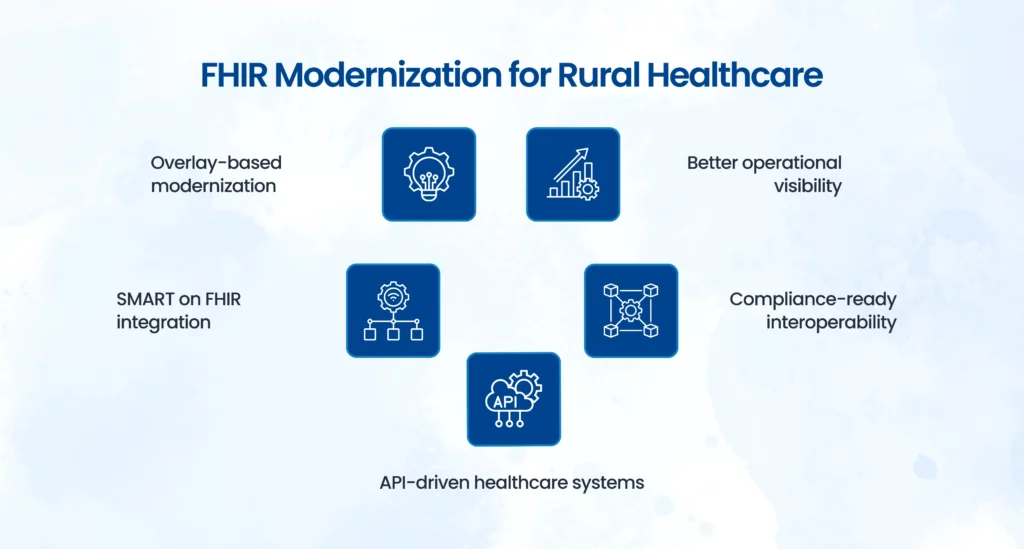
- SMART on FHIR application integration
- Modern healthcare workflows
- Improved scalability for digital health innovation
Healthcare organizations pursuing modernization initiatives are increasingly aligning systems with FHIR R4 compliance requirements.
FHIR R4 also enables easier integration with:
- Telehealth platforms
- Population health tools
- Care coordination systems
- Remote patient monitoring solutions
- Analytics platforms
- Healthcare AI applications
For rural hospitals, FHIR R4 creates a more scalable path toward connected healthcare operations.
What Is SMART on FHIR?
SMART on FHIR is a healthcare application framework built on top of FHIR interoperability standards.
It allows healthcare organizations to integrate third-party applications securely into existing healthcare systems.
SMART on FHIR enables:
- Secure patient authentication
- Standardized app integration
- Real-time clinical data access
- Improved provider workflows
- Better patient engagement experiences
For rural hospitals, SMART on FHIR helps modernize healthcare capabilities without replacing core EHR infrastructure.
This makes healthcare innovation more accessible for smaller organizations with limited budgets and IT resources.
The Risks of Ignoring Interoperability in 2026
Rural healthcare organizations that delay interoperability modernization may face increasing risks, including:
Operational Inefficiency
Disconnected systems create manual workflows that increase staff burden and reduce productivity.
Poor Care Coordination
Fragmented patient data can negatively impact continuity of care across providers.
Compliance Exposure
Evolving federal interoperability standards may increase reporting and operational risks.
Limited Scalability
Legacy infrastructure makes it difficult to adopt new healthcare technologies.
Reduced Patient Experience
Patients increasingly expect connected, digital-first healthcare experiences.
Difficulty Supporting Value-Based Care
Population health initiatives depend on accurate, connected healthcare data.
As healthcare ecosystems become more data-driven, interoperability gaps become increasingly difficult to manage.
How Overlay-Based Modernization Helps Rural Hospitals?
One of the biggest misconceptions about interoperability is that hospitals must replace their existing EHR systems completely.
In reality, many organizations are now adopting overlay-based modernization strategies.
Overlay-based modernization allows hospitals to:
- Add interoperability layers on top of existing systems
- Implement FHIR APIs gradually
- Modernize workflows incrementally
- Reduce infrastructure disruption
- Improve scalability without full EHR replacement
- Accelerate compliance readiness
This approach is especially valuable for rural hospitals with budget limitations and operational constraints.
Rather than rebuilding infrastructure from scratch, healthcare organizations can modernize strategically over time.
How FHIR Improves Rural Healthcare Operations?
Improved Care Coordination
Connected healthcare systems improve communication between providers and care teams.
Faster Access to Patient Data
Clinicians gain real-time visibility into patient histories and treatment information.
Reduced Administrative Burden
FHIR automates many manual data exchange processes.
Better Patient Experience
Connected systems reduce delays and improve continuity of care.
Enhanced Analytics Visibility
Healthcare leaders gain actionable operational and clinical insights.
Stronger Compliance Readiness
Modern interoperability frameworks help organizations prepare for evolving healthcare regulations.
Common Signs a Rural Hospital Needs Interoperability Modernization
Healthcare leaders should evaluate whether their organization experiences:
- Frequent manual data entry
- Delayed referrals
- Duplicate patient records
- Inconsistent reporting workflows
- Limited analytics visibility
- Disconnected healthcare applications
- Challenges integrating new digital tools
- Difficulty exchanging patient data externally
These are often indicators of growing interoperability limitations.
How Rural Hospitals Can Prepare for FHIR Adoption?
Successful interoperability modernization begins with a phased strategy.
Rural healthcare organizations should focus on:
Assessing Existing Integration Gaps
Identify disconnected workflows and data exchange limitations.
Evaluating Current EHR Capabilities
Determine whether existing systems support FHIR APIs and SMART on FHIR integration.
Prioritizing High-Impact Workflows
Focus on referrals, patient access, care coordination, and analytics visibility first.
Building Incremental Modernization Plans
Adopt overlay-based interoperability strategies to reduce operational disruption.
Strengthening Governance and Security
Ensure healthcare data exchange aligns with compliance and security standards.
Investing in Scalable Infrastructure
Create interoperability frameworks that support long-term digital transformation.
Why FHIR Is Becoming Essential for Rural Healthcare?
Healthcare interoperability is rapidly evolving from a technical initiative into a strategic operational requirement.
In 2026, rural hospitals that invest in interoperability modernization are better positioned to improve:
- Patient outcomes
- Operational efficiency
- Care coordination
- Regulatory readiness
- Digital health innovation
- Value-based care participation
- Long-term scalability
FHIR is becoming the foundation for connected rural healthcare ecosystems.
Organizations that modernize proactively will be better prepared for the future of healthcare delivery.
Conclusion
Rural healthcare organizations can no longer afford to treat interoperability as a future initiative.
As CMS requirements evolve and healthcare ecosystems become increasingly connected, FHIR readiness is becoming critical for operational sustainability, compliance preparedness, and patient-centered care delivery.
The good news is that modernization does not always require full infrastructure replacement.
Through overlay-based interoperability strategies, rural hospitals can modernize incrementally while protecting existing investments.
FHIR provides a scalable path toward connected healthcare operations, improved care coordination, and future-ready healthcare delivery.
For rural hospitals navigating modernization challenges in 2026, interoperability is no longer optional. It is essential.
FAQs
FHIR is a healthcare interoperability standard that enables secure, real-time exchange of healthcare data across systems and applications.
FHIR helps rural hospitals improve care coordination, modernize healthcare systems, strengthen compliance readiness, and reduce operational inefficiencies.
FHIR R4 is a widely adopted version of the FHIR standard that supports standardized APIs and scalable healthcare interoperability.
SMART on FHIR is a framework that allows healthcare applications to integrate securely with healthcare systems using FHIR standards.
No. Many healthcare organizations use overlay-based modernization strategies to add interoperability capabilities without full EHR replacement.
Healthcare regulations, CMS initiatives, value-based care models, and patient expectations increasingly require connected healthcare systems and real-time data exchange.
Categories
- 1115 Waiver (8)
- ACO (7)
- AI (48)
- Aigilx Health (48)
- CCBHC (8)
- Control Center (10)
- FHIR Facade (7)
- FHIR Server (14)
- HIE (5)
- Payers (8)
- Providers (11)
- Rapid Fire (9)

ISO 27001:2022 Certified
Aigilx health specializes in developing Interoperability solutions to create a healthcare ecosystem and aids in the delivery of efficient, patient-centric and population-focused healthcare.