TEFCA for Behavioral Health: Why a FHIR-First Strategy Matters in 2026
29 May

TEFCA for Behavioral Health: Why a FHIR-First Strategy Matters
Behavioral healthcare organizations are entering a new era of healthcare interoperability. In 2026, providers across the healthcare ecosystem are preparing for greater data sharing requirements, connected care delivery, and value-based healthcare initiatives. As interoperability becomes central to healthcare transformation, behavioral health organizations can no longer afford to remain disconnected from broader healthcare networks.
One of the biggest drivers behind this transformation is TEFCA (Trusted Exchange Framework and Common Agreement).
TEFCA is designed to create a nationwide framework for secure healthcare data exchange across providers, health systems, payers, and healthcare organizations. While many acute care and large health systems have already accelerated interoperability modernization, behavioral healthcare providers are now facing growing pressure to improve connectivity, care coordination, and patient data accessibility.
However, achieving TEFCA readiness requires more than compliance alone.
Behavioral healthcare organizations must adopt scalable interoperability strategies that support real-time data exchange, standardized APIs, and connected patient experiences. This is why a FHIR-first strategy is becoming essential.
FHIR (Fast Healthcare Interoperability Resources) provides the modern interoperability foundation needed to support TEFCA participation, improve care coordination, strengthen analytics, and enable connected behavioral healthcare ecosystems.
Organizations that invest in FHIR-based interoperability today are better positioned to meet future healthcare exchange requirements while improving both operational efficiency and patient outcomes.
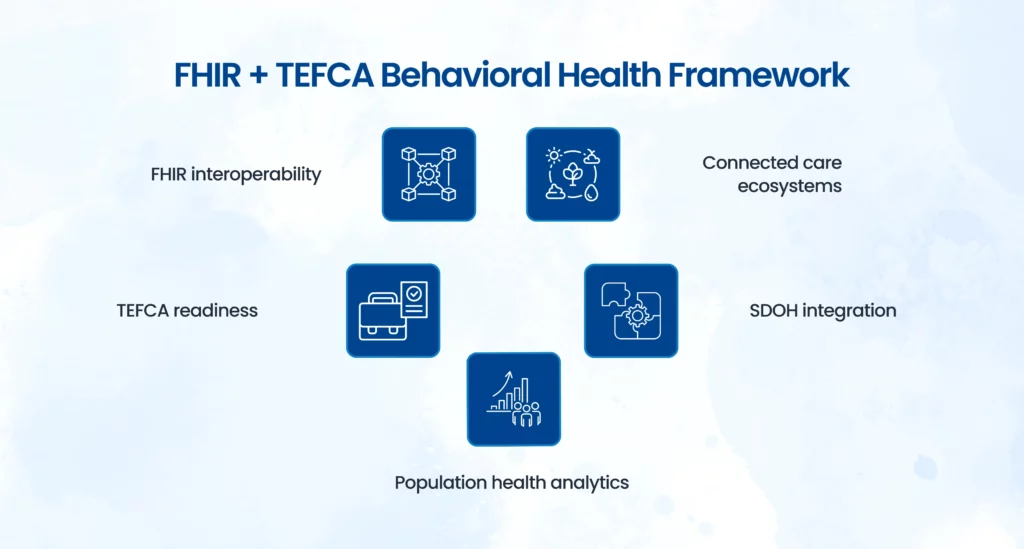
What Is TEFCA?
TEFCA (Trusted Exchange Framework and Common Agreement) is a nationwide interoperability initiative created to simplify secure healthcare data exchange across organizations and networks.
Its primary goals include:
- Improving healthcare interoperability
- Enabling nationwide health information exchange
- Reducing data silos
- Supporting secure patient data access
- Enhancing care coordination
- Standardizing healthcare exchange frameworks
- Improving patient-centered care delivery
TEFCA helps healthcare organizations exchange patient information more consistently and securely across different systems and care environments.
For behavioral healthcare providers, TEFCA creates opportunities to participate in broader healthcare ecosystems while improving visibility into patient histories, treatment plans, and coordinated care efforts.
What Is a FHIR-First Strategy?
A FHIR-first strategy prioritizes the use of FHIR APIs and modern interoperability standards when designing healthcare data exchange infrastructure.
Unlike legacy healthcare integrations that often rely on outdated interfaces and fragmented workflows, FHIR enables:
- Real-time healthcare data exchange
- API-driven interoperability
- Standardized patient information sharing
- Scalable integration frameworks
- Secure access to clinical records
- Improved healthcare application connectivity
- Better analytics and reporting capabilities
For behavioral healthcare organizations, FHIR creates the technical foundation necessary to support TEFCA participation and long-term interoperability modernization.
Why Behavioral Healthcare Faces Unique Interoperability Challenges
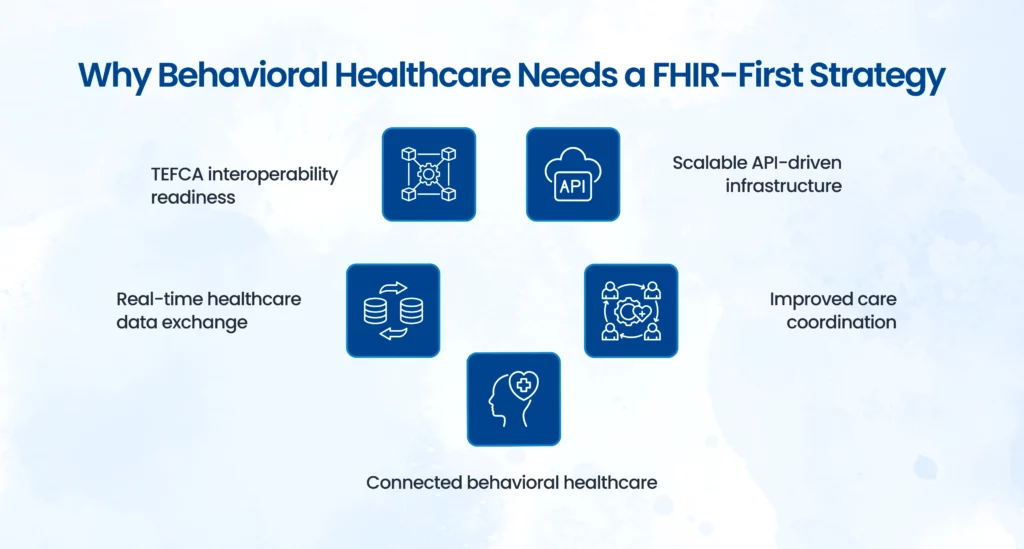
Behavioral healthcare environments are often more fragmented than other healthcare sectors.
Common interoperability challenges include:
- Legacy EHR systems
- Limited API capabilities
- Disconnected patient records
- Manual referral workflows
- Poor care coordination visibility
- Limited access to external clinical data
- Siloed social determinants of health (SDOH) information
- Resource and staffing limitations
These challenges make it difficult for behavioral healthcare organizations to fully participate in connected healthcare ecosystems.
Without interoperability, providers struggle to access complete patient histories, coordinate treatment plans across organizations, and identify high-risk patients proactively.
FHIR helps address these gaps through standardized, scalable, and API-driven interoperability.
Why TEFCA Matters for Behavioral Healthcare in 2026
Behavioral healthcare providers increasingly work alongside:
- Primary care providers
- Emergency departments
- Community health programs
- Crisis intervention teams
- Care coordinators
- Payers
- Social services organizations
Disconnected systems create delays, duplicate care efforts, and incomplete patient visibility.
TEFCA supports broader healthcare collaboration by enabling more consistent and secure data exchange across organizations.
For behavioral healthcare providers, this means:
- Faster access to patient information
- Better treatment continuity
- Improved referral management
- Enhanced care coordination
- Reduced administrative inefficiencies
- More informed clinical decision-making
As nationwide interoperability expectations increase, behavioral health organizations that remain disconnected may face operational and competitive disadvantages.
1. Supports Real-Time Interoperability
FHIR enables secure, API-based data exchange across healthcare systems.
This allows behavioral healthcare providers to access:
- Patient histories
- Medication records
- Care plans
- Emergency department visits
- Crisis intervention data
- Referral updates
- Social determinants of health information
Real-time interoperability improves both clinical workflows and patient experiences.
2. Improves Care Coordination
Behavioral healthcare often involves multiple providers and organizations.
FHIR helps improve communication between:
- Behavioral health specialists
- Primary care physicians
- Community organizations
- Case managers
- Emergency response teams
- Care coordinators
Connected data exchange reduces fragmentation and improves treatment continuity.
3. Strengthens Population Health Management
Population health strategies depend on connected patient data.
FHIR enables organizations to:
- Identify high-risk patients
- Monitor treatment adherence
- Track behavioral health trends
- Improve preventive interventions
- Analyze patient outcomes
- Reduce readmission risks
These insights help organizations deliver more proactive and data-driven care.
4. Enables Better Analytics and Reporting
FHIR supports advanced interoperability analytics capabilities.
Behavioral healthcare organizations can monitor:
- Patient engagement
- Care gaps
- Referral completion
- Treatment effectiveness
- Population risk stratification
- Operational performance
- Value-based care metrics
Improved analytics visibility supports stronger clinical and operational decision-making.
5. Future-Proofs Interoperability Investments
Healthcare interoperability requirements will continue evolving beyond 2026.
Organizations that adopt FHIR-first infrastructure today are better prepared for:
- Expanded TEFCA participation
- Future interoperability mandates
- AI-driven healthcare workflows
- Digital patient engagement
- Value-based reimbursement models
- Scalable healthcare innovation
FHIR provides a long-term interoperability framework rather than a temporary compliance solution.
The Role of Social Determinants of Health (SDOH)
Behavioral healthcare outcomes are heavily influenced by social and environmental conditions.
FHIR enables integration of SDOH data related to:
- Housing instability
- Employment challenges
- Transportation access
- Food insecurity
- Financial stress
- Community support systems
Integrating SDOH insights helps organizations deliver more personalized and comprehensive care strategies.
Common TEFCA Readiness Gaps in Behavioral Healthcare
1. Legacy Infrastructure
Older systems often lack modern interoperability capabilities.
2. Limited API Integration
Organizations may struggle to support scalable healthcare connectivity.
3. Fragmented Data Exchange
Patient records remain isolated across systems and providers.
4. Inconsistent Governance Frameworks
Organizations may lack standardized interoperability processes.
5. Limited Analytics Visibility
Disconnected systems reduce operational and population health insights.
FHIR-first modernization strategies help organizations close these interoperability gaps more effectively.
Key Benefits of a FHIR-First TEFCA Strategy
Improved Patient Outcomes
Connected care environments improve continuity and intervention timing.
Reduced Administrative Burden
Automation reduces manual workflows and fragmented integrations.
Better Operational Efficiency
FHIR streamlines healthcare data exchange and coordination processes.
Enhanced Compliance Readiness
Modern interoperability frameworks support evolving healthcare regulations.
Scalable Digital Transformation
FHIR creates a foundation for future healthcare innovation.
How Aigilx Health Supports TEFCA and FHIR Modernization
Aigilx Health helps behavioral healthcare organizations modernize interoperability through:
- FHIR-first integration strategies
- TEFCA readiness support
- API modernization
- Population health analytics
- Workflow automation
- Care coordination optimization
- Data governance frameworks
- Real-time interoperability solutions
By helping organizations build connected healthcare ecosystems, Aigilx Health supports scalable behavioral healthcare transformation.
Why Behavioral Healthcare Organizations Must Act Now
Healthcare interoperability is no longer optional.
As TEFCA adoption expands, behavioral healthcare organizations that delay interoperability modernization may face challenges related to:
- Care coordination
- Operational efficiency
- Patient engagement
- Compliance readiness
- Data accessibility
- Value-based care participation
FHIR-first strategies provide organizations with a scalable path toward connected, future-ready healthcare delivery.
Organizations that invest now will be better positioned to improve patient outcomes while adapting to evolving healthcare exchange requirements.
How Behavioral Healthcare Organizations Can Move Forward
Successful TEFCA readiness begins with a clear interoperability roadmap.
Behavioral healthcare providers should focus on:
- Assessing interoperability gaps
- Modernizing legacy systems
- Implementing FHIR APIs
- Improving analytics capabilities
- Integrating SDOH data
- Strengthening care coordination workflows
- Building scalable interoperability frameworks
With the right interoperability strategy and technology partner, behavioral healthcare organizations can build connected ecosystems that support both operational growth and improved patient care.





FAQs
TEFCA (Trusted Exchange Framework and Common Community) is a regulatory framework that promotes secure and interoperable health information exchange between healthcare entities.
TEFCA helps behavioral healthcare providers improve care coordination, patient data accessibility, and participation in connected healthcare ecosystems.
A FHIR-first strategy prioritizes API-driven interoperability using FHIR standards to improve healthcare data exchange and scalability.
FHIR enables standardized, secure, and real-time interoperability needed to support TEFCA participation and healthcare connectivity.
Interoperability reduces fragmented care, improves communication between providers, and supports better patient outcomes.
Aigilx Health provides FHIR integration, interoperability modernization, TEFCA readiness support, analytics solutions, and workflow automation.
Categories
- 1115 Waiver (8)
- ACO (7)
- AI (46)
- Aigilx Health (46)
- CCBHC (8)
- Control Center (10)
- FHIR Facade (7)
- FHIR Server (14)
- HIE (5)
- Payers (8)
- Providers (11)
- Rapid Fire (9)

ISO 27001:2022 Certified
Aigilx health specializes in developing Interoperability solutions to create a healthcare ecosystem and aids in the delivery of efficient, patient-centric and population-focused healthcare.