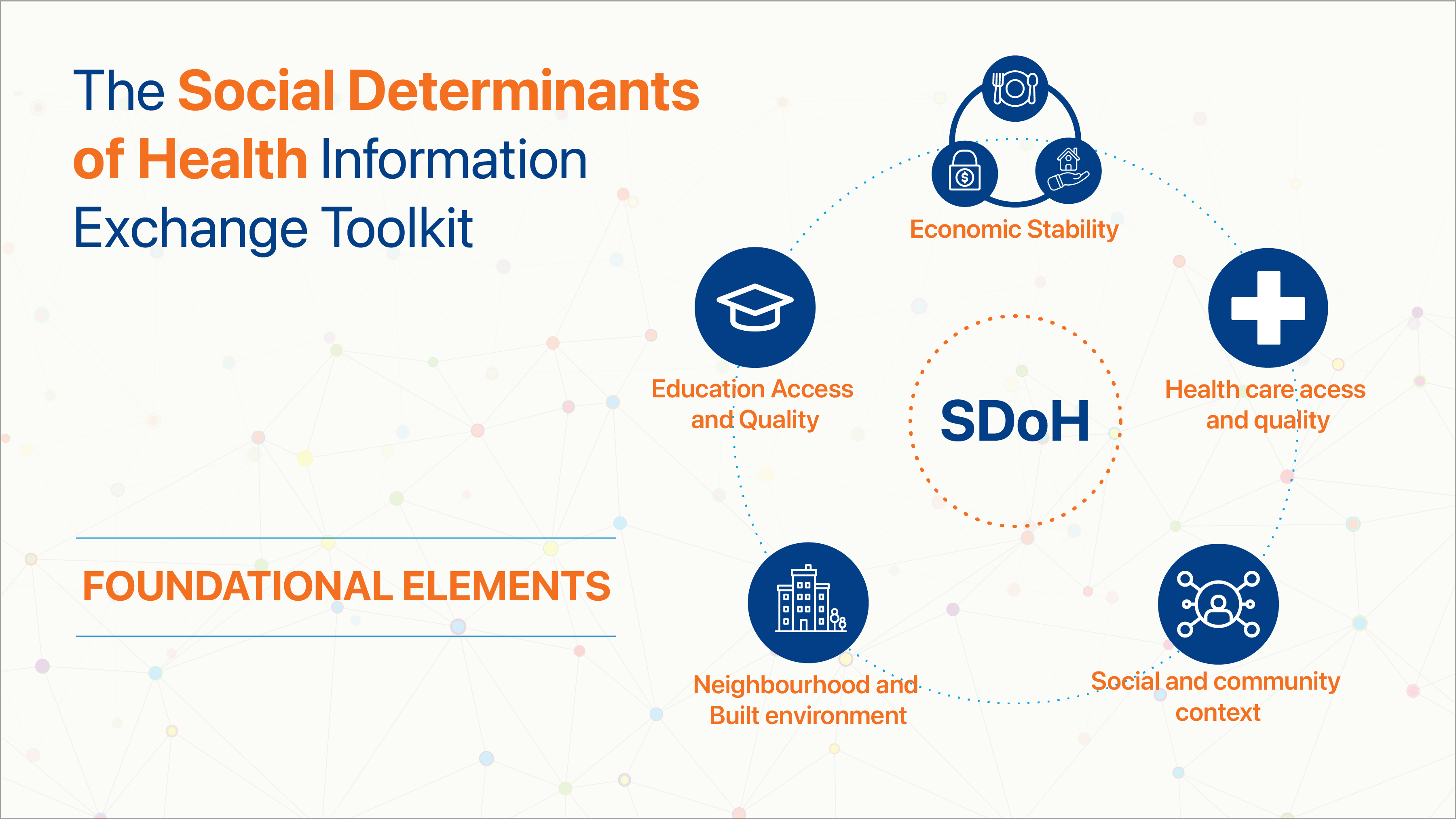
In an effort to advance SDOH Information exchange and achieve HHS’s Healthy People 2030 Framework vision, ONC has published The Social Determinants of Health Information Exchange Toolkit.
This toolkit aims to provide information and resources for stakeholders to achieve SDOH information exchange goals, including approaches to consider foundational elements, common challenges and opportunities, and questions to inform implementation.
It outlines 10 interrelated Foundational Elements such as mission and purpose, policy, legal and others which, when tied with governance will help assess an initiative’s capacity to build interoperable components.
Community Readiness and Stewardship: Assessing community willingness, capacity, and shared responsibilities through co-design, evaluation, and decision-making.
Mission and Purpose: Explicitly stating the initiative’s intention, value propositions, vision, scope, and expected benefits.
Values and Principles: Establishing ethical standards for action and decision-making towards health equity.
Policy: Considering federal, state, and local policies to collect, share, and use standardized SDOH data, and collaborating with relevant efforts for improved outcomes.
Legal: Establishing processes, operations, rights, and obligations to support data use and sharing and comply with laws.
Measurement and Evaluation: Monitoring performance metrics, outcomes, effectiveness, and quality management and improvement.
Financing: Identifying funding sources, plans, opportunities, and incentives for community adoption and use.
Implementation Services: Technical and programmatic services to support adoption and utilization.
Technical Infrastructure and Data Standards: Aligning hardware, software, data, processes, and standards for scalable and interoperable systems.
User Support and Learning Network: Identifying community needs, providing education, training, and technical assistance, and sharing promising practices and lessons learned.
Governance: Decision-making processes and groups, including as related to institutional, administrative, and data governance.
The Foundational Elements can impact the initiative’s ability to create interoperable infrastructure components. These Elements are interconnected, and governance plays a role in all of them. Stakeholders can prioritize and focus on the Elements based on their needs.
ONC states that the Foundational Elements framework is not a uniform solution, but instead, a guiding framework for planning, designing, implementing, and evaluating SDOH information exchange initiatives. The toolkit also includes Case Studies with relevant Foundational Elements to explain their use.
Healthcare players implementing SDOH information exchange initiatives can utilize the Toolkit to navigate evolving healthcare situations. SDOH information exchange initiatives that are community-led and rely on interoperability standards can significantly contribute to enhancing health outcomes and promoting health equity.
Aigilx health specializes in developing Interoperability solutions to create a healthcare ecosystem and aids in the delivery of efficient, patient-centric and population-focused healthcare.
This website stores cookies on your computer. These cookies are used to collect information about how you interact with our website and allow us to remember you. We use this information in order to improve and customize your browsing experience and for analytics and metrics about our visitors both on this website and other media. To find out more about the cookies we use, see our Privacy Policy.
If you decline, your information won’t be tracked when you visit this website. A single cookie will be used in your browser to remember your preference not to be tracked.